Tuesday, September 19, 2006

Consistently Inconsistent

An editorial in today's Wall Street Journal hits the nail on the head concerning the recent Islamic outrage in response to Pope Benedict XVI's quoting of Byzantine emperor Manuel II Paleologus (Don't settle for the sound bite. You can read the full text of the Pope's speech here.):
By their reaction to the pope's speech, some Muslim leaders showed again that Islam has a problem with modernity that is going to have to be solved by a debate within Islam. The day Muslims condemn Islamic terror with the same vehemence they condemn those who criticize Islam, an attempt at dialogue--and at improving relations between the Western and Islamic worlds--can begin.
The piece also touches upon a question that though perhaps politically incorrect, is nevertheless important. Does the Islamic doctrine of Allah preclude reasonable dialogue? Please note, this is not to inquire whether adherents to the Islamic faith are capable of being reasonable. Obviously, many are. But when they are, are they being consistent with the nature and character of Allah as they conceive of him? As the editorial notes, according to the Christian faith, "God is inseparable from reason" since, as Pope Benedict quoted from the first chapter of John's gospel, "In the beginning was the Word" (lit. logos, meaning "reason" or "word"). In Christian theology, logic and rationality are grounded in the nature of the eternal and triune God. God cannot act illogically or irrationally because he cannot act contrary to his own nature.

On the contrary, the Muslim vision of God is that he is so transcendent that he has no limitations whatsoever, not even those of his own nature. Thus, immutability or unchangeableness is not ascribed to Allah by Muslims. Addressing this point in their book Muslims and Christians at the Table: Promoting Biblical Understanding Among North American Muslims, Bruce McDowell and Anees Zaka write:
This means that Allah is never bound to a decision that he once made. He cares nothing about being consistent. Therefore, he did not hesitate, when circumstances required, to change and rescind his earlier revelations, even when they contained specific commandments and instructions to believers. This created conflict for Muhammed, since he claimed to be transmitting a divine message that was inscribed upon tablets preserved in heaven, and which therefore should be eternal and unchangeable. But, as circumstances changed, Muhammed did not hesitate to assert that Allah had abrogated his earlier revelation and substituted another....Another aspect of the irrational nature of Allah's will is that he often makes offensive or misleading statements in order to "prove" men or stir up unbelievers to contradict the revealed word (Surah 74:31; 17:46). This is all utterly opposed to the Christian view of God as one who is immutable and true (pp. 102-103).
The authors proceed to explain how any attributes ascribed to Allah are regarded as descriptions of his absolute will rather than essential characteristics of his nature. The practical implications of this theology? "For the Muslim, there is no absolute truth in Allah or in ethics" (p. 103). Another consequence of this doctrine is, as one scholar whom the Pope quoted noted, that "[Allah's] will is not bound up with any of our categories, even that of rationality."

As much as some insist on separating terrorist acts from their perpetrators' religious beliefs, we need to realize that theological convictions have undeniable practical outworkings, a point clearly made in Sam Harris's recent L.A.Times opinion piece. Harris is right to claim that the the growing culture of death in the Muslim world is consonant with the Islamic doctrines of martyrdom and jihad. Likewise, he is correct in calling the "war on terror" a fight "against
a pestilential theology and a longing for paradise."

I cannot rid myself of the question. Who is being most consistent with the inconsistent deity of Islam - peace-loving, moderate Muslims or those willing to justify all manner of atrocities in his name?


Monday, September 18, 2006

A MySpace Primer for Parents

A few months ago I attended a seminar for parents conducted by one of our local police officers at neighborhood middle school. The officer was sharing information from i-Safe, a group specializing in internet safety education. I was surprised at the reactions of many of the parents upon learning just what their children were capable of doing with their home computers and an internet connection. Eyes widened and jaws dropped as technologically-challenged parents were introduced to the world of webcams, instant messaging, and social networking.

U.S. News & World Report recently ran a cover story for parents appropriately titled "Decoding MySpace." It's filled with helpful information and a few unsettling statistics like the following:

Parents who would never allow their child to go to a party unless they knew that an adult would be present let their kids pilot themselves through the online world without any supervision whatsoever. A June survey of 267 pairs of teens and parents in the Los Angeles metropolitan area by a psychology professor at California State University-Dominguez Hills found that two thirds of parents had never talked with their teen about their MySpace use, and 38 percent of them had never seen their child's MySpace profile. "Parents are chicken," says Parry Aftab, an Internet privacy lawyer and executive director of WiredSafety.org..."They don't understand the technology, so they're reluctant to get involved."
I'm sure technological ineptitude is partially responsible for parents' non-involvement with their teens' online activity. But I suspect another factor is at least as much to blame if not moreso. Many parents dread the thought of their kids not liking them and consequently refuse to "invade" their "privacy" or enter into any kind of conversation that might seem like snooping. Michelle Alden, one of the mom's mentioned in the article, is not one of them:
The 40-year-old teacher's aide in Idaho City, Idaho, says she is uncomfortable with the site's profile format, as it encourages youngsters to present themselves as if they're looking for sex. Why, she wonders, does the site ask kids to describe their body type and sexual orientation? But instead of trying to forbid the site, she's opted to set guidelines and talk regularly with her 15-year-old daughter about her page, which she uses primarily to stay in touch with friends. "I think it's better to go ahead and have the struggle, because soon enough she's going to be out on her own," she says, "and I only have a few more years to have those conversations with her."
Some of the best parenting advice my wife and I ever received was from the wife of one of our pastors who said, "Your kids are not going to like you for some reason so you'd better make sure it's a good one."

Thursday, September 14, 2006

Evolution - I.D. Debate on Tomorrow's Michael Medved Show

Doug Groothuis posted the following announcement from the Discovery Institute listserve:

Authors to Debate Darwinism vs. Design on National Radio Program, Friday Sept. 15

Mark your calendars for 1pm PST tomorrow. You won't want to miss this one. Biologist Jonathan Wells [
Icons of Evolution] will debate blogger Chris Mooney [The Republican War on Science] on the science behind Darwinism and intelligent design. They will be the guests on The Michael Medved Show from 1-2pm PST. Visit Medved's station finder page to find the station in your local area. The program is broadcast live all over the country, so if you want to ask questions, the call-in number for Medved's show is 1-800-955-1776.

Lee Eclov on the Dangers of Practical Preaching

Everyone who preaches or listens to sermons should check out an excellent two-part article by Lee Eclov recently posted at Out of Ur. Lee takes on two popular misconceptions about biblical preaching: The Bottom Line Fallacy and the Practical Fallacy. Both, he says, demonstrate misunderstanding not only about preaching but how Scripture works:

The Bible spends much more time on shaping the spiritual mind than commanding particular behavior. We need far more training in the ways of grace, of spiritual perceptions, and of what God is really like, than we do in how to communicate with our spouse. Understanding the glory of Christ is far more practical than our listeners imagine. Properly preached, every sermon based on a passage of Scripture is fundamentally practical. Every author of Scripture wrote to effect change in God's people. It is our job as preachers to find the persuasive logic of that author and put that clearly and persuasively before our people through biblical exposition.
Thank you, Lee!

Wednesday, September 13, 2006

Why Pod?

Doug Groothuis, the Constructive Curmudgeon, is thinking about getting an mp3 player and is asking for feedback on their advantages as well as on which to purchase. Reading Jim Bublitz's post on how to buy and reform your mp3 player persuaded me to finally take the plunge and I'm glad I did.

Christians and the Psychiatric Culture


Last night I finished reading a book I mentioned here a few weeks ago, Will Medicine Stop the Pain?: Finding God’s Healing for Depression, Anxiety, and Other Troubling Emotions by Elyse Fitzpatrick and another biblical counselor, Laura Hendrickson, a physician who formerly practiced psychiatry. The book targets women since, according to the American Academy of Family Physicians, twice as many women as men will experience depression in their lifetime.Hendrickson not only prescribed antidepressants to her patients but for a period took them herself to treat diagnosed depression and bipolar disorder. She candidly relates her experiences with childhood rejection, subsequent emotional instability, and drug-induced confusion including suicidal and homicidal thoughts. Other first person accounts from Christian women who have struggled with depression appear throughout the book.

The authors explain how modern psychiatry frequently operates on the premise that human beings are reducible to our biochemical components. Intense emotional pain is therefore concluded to be the result of physical disease. They contrast this materialistic perspective with a biblical view of the person as consisting of the uniting of the outer man (the physical body including the brain) and the inner man which is referred to biblically by terms like the heart, mind, spirit, and/or soul. Fitzpatrick and Hendrickson acknowledge that the body can affect and influence the heart and vice versa. They also concede that there are real, empirically verifiable diseases of the brain (as well as brain injuries) that can have negative effects on one’s perception, cognition, and moods. However, they point out that there are no tests for so-called imbalances in brain chemistry for which antidepressants are said to be correctives. They also claim that emotional pain is intended to inform us what is going on in our hearts so that we might avail ourselves of the resources that are ours in Christ to experience heart transformation.

Fitzpatrick and Hendrickson take great pains to caution readers currently on antidepressants against deciding to go off them without medical supervision.  One of the medical professionals frequently cited is Joseph Glenmullen, a psychiatrist who teaches at Harvard Medical School and is also in private practice. I had seen him on ABC's Prime Time Live two years ago and had thought at the time of picking up one of his books but never got around to it. (Dr. Glenmullen's responses to Prime Time viewers' questions about antidepressant side effects and withdrawal are available here.) Glenmullen authored Prozac Backlash and more recently, The Antidepressant Solution which I’m in the midst of reading.

While he prescribes antidepressants on a limited basis, Glenmullen has been a very outspoken critic of the pharmaceutical companies' campaign to market them to physicians and the general public. He believes that the majority of Americans currently taking them are doing so unnecessarily. He is also very concerned that many physicians, who are often reliant upon the drug companies for their information about the drugs and their effects, are ignorant about antidepressant dependence, withdrawal, and how to safely taper patients off them. It’s frightening to learn how misleading pharmaceutical companies have been in their pushing of various medications, many times suppressing evidence of ineffectiveness and/or harmful side effects. According to Glenmullen, ample evidence exists indicating that in some people, antidepressants can create the very symptoms they were prescribed to treat. And in some cases, such a dependence is built that serious symptoms can result from forgetting to take the pills at their proper time. When this happens, patients often think that they are having a relapse when, in actuality, the drug is responsible for their problems.
I can't recommend the above books highly enough to those taking antidepressants (whether male or female) and those who care about someone who is. Readers may also be interested in acquiring a Mars Hill Audio Journal interview with David Healy, a British psychiatrist and author of The Antidpressant Era and more recently Let Them Eat Prozac: The Unhealthy Relationship Between the Pharmaceutical Industry and Depression on antidepressants and the concept of disease.

When one takes into consideration that the disorders the psychiatric community labels people with, are not scientifically validated, there is much cause for both alarm and caution. I’m especially concerned because I know numerous Christians who have bought the well-publicized line that taking antidepressants is analogous to taking insulin or other medication designed to treat biologically detectable illnesses. In a chapter on biological psychiatry in his book Seeing With New Eyes: Counseling and the Human Condition Through the Lens of Scripture, David Powlison makes what I believe is an accurate observation:
The church typically lags a bit behind the culture's way of thinking. But the ethos and practice of biopsychiatry are deeply affecting the church already. If it's broken, or even just not working optimally, it can be fixed from the outside by a drug: better living through chemistry. In your ministry and in your church you are probably already facing the ethos and the practices. Many people in both pew and pulpit are on mind-, mood-, and behavior-altering drugs. We all increasingly face the ideas and knowledge claims, too. The cover story in Time magazine informs the everyday queries and choices of Christian people. Eventually such ideas make it into the educational system as the received wisdom of the culture with which to disciple the next generation (p. 243)
The more believers uncritically accept the therapeutic ethos that so permeates our culture, the less relevant and precious the gospel will seem.

Related Tags: , , , , , , , , , , ,

Thursday, September 07, 2006

Greeting Card Theology

I spent a small portion of my Labor Day weekend doing something I can't stand - searching for a greeting card. I've never timed myself but innocent trips to the corner drugstore to pick up a card for a friend or family member have turned into what seemed like card-hunting marathons, with me in search of just the right message. I've spent so long in the card aisle on some occasions that I felt like a loiterer.

The reasons for my protracted perusal are due to consideration of style and substance. My maternal grandmother, with whom I spent a good portion of my childhood, was an avid poet. She couldn't stand what she called "sing-song" poetry, the kind with a cadence that sounds more like a nursery rhyme or limerick. I think I inherited her disdain for such verse. Consequently, I search hard for the few cards that don't contain it.

My bigger beef with so much of what is offered by way of greeting card fare is with the messages themselves, at least in the case of those cards intended to convey a serious thought. (Finding humorous cards is much easier though I must confess those that evoke the greatest laughter from me would be inappropriate to give to anyone except a few of my closest friends.) So many of the messages are so saccharine-sweet and syrupy that there ought to be legislation requiring stores to provide barf bags in the card aisle. Cards related to marriage (for newlyweds, anniversaries, Mother's and Father's Day from a spouse) are some of the worst offenders. Countless times I've stood in a store, reading a card and thinking to myself, "I can't give this to my wife. She'll see right through it!"

Many times I've felt guilty, wondering if something was wrong with me because my feelings don't match the ebullient expressions of bliss printed in practically every card. If this is normative of the marital experience, then perhaps I (and, let me be quick to add, my wife) married the wrong person. I felt a wave of relief when, a few days ago, I mentioned my thoughts on this topic to a friend in a solid marriage of 45 years who said that when looking for a card for her dearly loved husband, even she occasionally wonders why there is such a disparity between her experience and the sentiments expressed in most cards. Her conclusion, with which I wholeheartedly agree, is that the thoughts conveyed in most marriage-related cards are unrealistic.

I expect such froth from secular card manufacturers but what I find so tragic is that cards produced by Christian companies contain just as many romanticized notions of marital love. Usually, the only difference is that they throw in references to "prayer," "God," and sometimes, "Jesus." If anyone is to offer a realistic rendering of marriage it should be those who claim to believe and build their lives on God's special revelation but sadly, this is rarely the case, at least from my limited experience. When it comes to marriage, Christian cards are strong on the doctrine of creation, affirming that the institution is God's plan. They are woefully lacking, however, in acknowledging the fall and its obliteration of Edenic relationships. Consequently, the Lord's redemptive purpose in the lives of sinful yet redeemed men and women is rarely mentioned.

Last weekend, while in search of a card for friends recently married, I read numerous cards assuring the newly married couple that the sender was praying for a life of "happiness and blessing" for them as though there were no higher purpose for their union. I've not yet seen a card that said something like "Praying that you will be receptive to the ways the Lord will use you to perfect holiness in each other's lives" or "Praying that you will endure in fidelity to Christ and each other through the joys and trials you will share." These are the kinds of prayers marriages need. I know that when newlyweds are ripping envelopes open and collecting checks, they may not be all that attentive to what's printed in a card anyway, but with all the myths surrounding marriage, shouldn't we look for every opportunity to keep a true vision before each other's eyes? In doing so, we contend against lies and misconceptions that lead to much unnecessary disappointment and disillusionment.

The Christian greeting card industry would do well to imitate the kind of authenticity expressed in the lyrics of a Sara Groves tune called "Roll to the Middle," a beautiful expression of marital love and commitment even on the heels of heated argument. Here are the words:

We just had a World War III here in our kitchen
We both thought the meanest things
And then we both said them
We shot at each other till we lost ammunition

This is how I know our love
This is when I feel it’s power
Here in the absence of it
This is my darkest hour
When both of us are hunkered down
And waiting for the truce

All the complicated wars
They end pretty simple
Here when the lights go down
We roll to the middle


No matter how my pride resists
No matter how this wall feels true
No matter how I can'’t be sure
That you're gonna roll in too
No matter what, no matter what
I'm going to reach for you
I think I'm going to send a "Get Well Soon" card to some Christian card companies.

Saturday, September 02, 2006

On Blogging

MercatorNet's weekly update focuses on blogging. Here's the lineup:

WILL BLOGS DESTROY ENGLISH?
By Michael Cook
Never before have so many people written their thoughts for the world. Will English literature survive the flood?


IT'S DOG EAT DOG IN THE BLOGOSPHERE'S FOOD CHAIN
By Matthew Mehan
Nature may be red in tooth and claw, but it's kind compared to the evolutionary struggle for supremacy among bloggers.

WHO NEEDS DRUGS? I'VE GOT A BLOG
By John Bambenek
With more than 50 million blogs on the internet, it's clear that too many people have too much time on their hands.

Sire on Simply Christian

James Sire briefly reviews N. T. Wright's Simply Christian calling it "simply outstanding."

A House Divided

The L.A. Times profiles and contrasts Calvary Chapel founder, Chuck Smith and son, Chuck Smith Jr.

Thursday, August 31, 2006

Wednesday, August 30, 2006

Spurgeon on Our Chief Tormentors

"Many of God's people are constantly under apprehensions of calamities which will never occur to them, and they suffer far more in merely dreading them than they would have to endure if they actually came upon them. In their imagination, there are rivers in their way, and they are anxious to know how they shall wade through them, or swim across them. There are no such rivers in existence, but they are agitated and distressed about them....They stab themselves with imaginary daggers, they starve themselves in imaginary famines, and even bury themselves in imaginary graves. Such strange creatures are we that we probably smart more under blows which never fall upon us than we do under those which do actually come. The rod of God does not smite us as sharply as the rod of our own imagination does; our groundless fears are our chief tormentors."

From C. H. Spurgeon's sermon, "Our Needless Fears," quoted in
Will Medicine Stop the Pain?: Finding God's Healing for Depression, Anxiety & Other Troubling Emotions by Elyse Fitzpatrick and Laura Hendrickson, M.D.

Tuesday, August 29, 2006

Learning and Teaching How to Watch Movies Worldviewishly

Prompted by an inquiry from a friend, Jeff at The Dawn Treader has posted a helpful list of recommendations and resources for parents wishing to instill the ability to think "worldviewishly" about films in their children and teens. In addition to the fine books he mentions, I'd add another title - Hollywood Worldviews: Watching Films with Wisdom & Discernment by Brian Godawa.

Though it doesn't target parents specifically, this book would certainly benefit any adult wanting to engage young people in intelligent, faith-informed conversation about movies and their meanings. Godawa is an experienced screenwriter who combines his inside knowledge of the industry with his knowledge of Christian theology, philosophy, and apologetics resulting in an informative guide that not only helps readers learn how to think Christianly about films but also to understand a film's underlying structure (e.g., theme, hero, hero's goal, the adversary, character flaw, final confrontation, resolution). Godawa posits that the essence of storytelling in movies is about redemption.

A movie takes a hero with an inner flaw, who desires something and has a plan to get it. But he is blocked by an adversary until he almost fails but finally finds a solution. This process of goal, flaw, failure, and self-revelation is the process of paradigm change or conversion in an individual.
Movies, therefore, offer diagnoses about what ails us as well as prescriptions for setting it right. They are, in that respect, "incarnate sermons." Cinematic storytellers are, says Godawa,
...engaging in their craft with an intent to communicate their view of the world and we ought to live in it. They have discovered the power of a well-told story combined with a well-thought-out philosophy that is creatively embodied in the story through character, plot and image. In the same way that worldviews involve a network of individual ideas that are interconnected to serve a greater philosophical interpretation of our experience, so movies are a network of events, images and themes that serve a unified way of interpreting our experience through the effective means of drama.
In an early chapter on the nature of stories and mythology, Godawa claims that Christianity alone provides justification for as well as makes sense of storytelling. "...the biblical notion of linear history, with an author, characters and a purposeful goal, was the philosophical foundation for the search for meaning in a narrative of life. Storytelling is meaningless gibberish unless reality itself is narratable."

The book is divided into three parts. The first, consisting of two chapters, "Stories & Mythology" and "Redemption," is called Storytelling in the Movies. Part Two is called Worldviews in the Movies and includes chapters on existentialism, postmodernism, and other worldviews. In each case, Godawa offers ample illustrations from well-known films. Part Three is called "Spirituality in the Movies" with chapters on "Christianity," "Angels & Demons, Heaven & Hell," and "Faith." Each chapter concludes with discussion questions and sidebars refer readers to related web resources (most often Godawa's site) and books (including James Sire's The Universe Next Door, which Jeff highly recommends in his post). An appendix deals with the issues of sex, violence, and profanity in the Bible and asks whether there is ever any Christian justification for the dramatic portrayal of evil.

I seriously doubt this one will be turned into a movie so don't wait for it. Read the book!

Related posts:
A Call for Artist-Apostles: More on Faith and Film
Using Films to Rattle Cages: Movies and Apologetics

Friday, August 25, 2006

The Blessing of Pets

In a recent comment on this blog, my good friend Jerry in Iowa mentioned that a church in his area holds an annual service to which congregants bring their pets to receive blessings. I'm still awaiting verification but my sources tell me that the dog pictured to the right participated in one of those services and is now actively involved at Hymns & Hounds, a church where dog lovers and their best friends can worship together.


 Meanwhile, elsewhere in America's heartland, an Illinois woman believes that the image of the Virgin Mary has appeared on one of her pet turtle's shells. Again, this awaits further verification but rumor has it that plans are underway for the turtle to travel to Iowa (on the dashboard, of course) to preside over the next pet blessing service.

Thursday, August 24, 2006

Jason Janz on Jesus Junk

Jason Janz at SharperIron gives an eyewitness report (complete with photos) of his experience at the recent Christian Bookseller's Association Convention International Christian Retail Show. He asks, "Why do we as Christians, feel compelled to plaster our 'faith' over anything and everything?" (a question I took a partial stab at recently) and offers the following reasons:

  1. Many people trust that wearing Jesus Junk will result in conversions.
  2. Many Christians believe Jesus Junk promotes Christian community.
  3. Many people seem to be in the business for pure commercialism.
He concludes with five thoughtful questions believers should ask before buying more Christianized merchandise.

I don't know. Jason makes a persuasive case but I'm still tempted to get my son fitted for that neat armor of God outfit he photographed.

Tuesday, August 22, 2006

Church-Based Theological Education

Stonebriar Community Church, where Chuck Swindoll serves as senior pastor, has developed a theology program endorsed by J. P. Moreland and John Frame among others. It's a part of Credo House Ministries. Here's how they describe it:
Most simply put, The Theology Program (TTP) is on a mission to reclaim the mind for Christ by equipping people, churches, and pastors, to understand and defend the Christian faith. The Theology Program is a program of Christian theology (study of God) and apologetics (defending the faith) created with all believers in mind. TTP seeks to give people who may never have the time, ability, or circumstances that allow them to attend full-time seminary the same opportunity to study the great and rich Christian heritage of truth. Here, you will learn theology historically, biblically, and irenically (in a peaceful manner). The contents of TTP are created from a broadly evangelical perspective, engaging other traditions in a persuasive yet gracious manner. In short, we seek to help people think theologically by understanding what they believe and why they believe it.
We believe that all people are created in the image of God and therefore able and desirous to engage in a deep level of theological training that has traditionally only been offered at seminaries. TTP courses are designed with you in mind, walking you step by step through this comprehensive program.

Monday, August 21, 2006

Another Look at Jesus and 'Porn Stars'

At Boundless Webzine, Matt Kauffman responds to objections from readers of his previous article questioning the evangelistic strategy of Pastor Craig Gross and other members of a ministry reaching out to erotic entertainers at a recent pornography trade show. At issue is the wisdom of leading with the message "Jesus Loves Porn Stars." (Gross and his ministry partners handed out about 3,000 Bibles whose covers sported those words at the convention.) Matt offers sound counsel for all of us who are prone to gloss over the issue of sin and judgment in order to quickly present the good news of God's love:
The greatest temptation for Christians today, however, is not to be too harsh, much as some may be guilty of that; it's to be too soft. In the name of being winsome, we're pulled to go along with a live-and-let-live society that seeks nothing so much as freedom from moral strictures and hard truths. And even when we may not intend to do so, we have to realize that society around us is all too eager to find the only "true" Christianity in a religion that fits comfortably into that worldview.
In the ears of most who hear it, "Jesus Loves Porn Stars" fits the bill. And that's why, whatever else may be said for or against the people who've chosen to lead their witness with those words, it's simply sending the wrong message.

Thursday, August 17, 2006

Oh, Lord, is it Hard to be Humble, When You're Certain in Any Way?

As I read various responses to Newsweek's recent feature article about Billy Graham, the following thought occurred to me: A jaundiced eye and rose-colored glasses both obscure vision. Melinda Penner and Dan Phillips avoid those extremes while addressing a pertinent issue raised by the piece. 

Surprise!

Atheist author of The End of Faith, Sam Harris, reviews Francis Collins' (director of the Human Genome Project) new book, The Language of God, calling it The Language of Ignorance.

More about Collins in the LA Times: "Faithful to God, Science"

Wednesday, August 16, 2006

Driving the Marketplace Out of American Christianity

A handful of people were directed to a recent post on Christian retailing after doing searches for "gospel golf balls" or something similar. The LA Times article linked to in that post quotes Alan Wolfe, a non-Christian sociologist who has done a lot of research about American evangelism. When asked what he thinks the proliferation of Christianized products reveals, Wolfe replied, " "It's as if they're saying the task of bringing people to Jesus is too hard, so let's retreat into a fortress."


The above searches in combination with the fact that just last week someone offered me a fish-shaped "Scripture Mint" prompted me to link to this interview of Wolfe by Russell Moore on a recent broadcast of the Albert Mohler Program (HT: Justin Taylor) in which Wolfe had more indicting commentary about Christian retailing. It's painful listening because so much of what he offers as reasons for the mass production of so-called evangelistic merchandise is true.

I think there's another reason behind the impulse to stamp a Scripture verse on every imaginable object. In large part we have an anemic doctrine of creation. Our conviction that God is the maker of heaven and earth should be evidenced in more ways than ongoing debates with evolutionists. Certainly, there's a need for such apologetic activity but the doctrine of creation, like all biblical doctrines, is not given primarily for the purpose of our defending it but for our living it.

How do we live the doctrine of creation? By affirming along with God that his creation, though cursed on account of humanity's rebellion, is still good and is given to us to richly enjoy with thanksgiving (1 Timothy 4:4; 6:17). As Michael Wittmer says in his book, Heaven is a Place on Earth:


Because we know that this creation is the good gift of God, we are not only permitted but encouraged to enjoy it as is. Unlike those who think that worldly objects are somehow enhanced by stamping Scripture verses on them, Christians who understand the goodness of this world celebrate the freedom to enjoy God's creation as is. We no longer need to sanitize secular items with our sanctified slogans to make them suitable for Christian consumption....In fact, our feeble attempts at baptizing creation tend to cheapen both it and the gospel (p. 66-67).
If believers really grasped this, many Christian businesses would go belly up and perhaps Christian "bookstores" would become bookstores again.

By the way, if you'd like a concentrated dose of the kind of creation- and gospel-trivializing merchandise Wittmer refers to, the Ship of Fools' collection of Gadgets for God is hard to beat. Among their current list of top-ten products is a lanyard and cap designed to convert your iPod Shuffle into a cross. Click the picture for their description and ordering information.

Tuesday, August 15, 2006

PC Down Under

Two Australian pastors are facing jail time for comparing Christianity and Islam.
"Pastors Daniel Scot and Danny Nalliah are victims of a rogue law that tramples on religious freedoms protected by international law," said Seamus Hasson, the Becket Fund's President. "Instead of promoting religious tolerance, the Act cultivates disharmony and suspicion. This law makes people afraid to engage in any genuine dialogue about religious beliefs because someone may end up taking them to court just for having an opinion!"
Read the whole story.

Monday, August 14, 2006

"We Need 'Apostolic' Theologians"

I finished reading Robert Banks's Redeeming the Routines: Bringing Theology to Life last night. (OK, everything except the appendix.) As I noted last week, the premise of the book is that theology and theological education are in need of being reconceptualized so as to address the daily pressures, responsibilities, and activities that form the patterns of our lives. This is necessary to foster holistic living contrary to the inclination to divvy up our lives into two realms: the spiritually significant that consists of overtly "religious" activity and everything else with which most of our waking hours are spent but about which there is little theological reflection. Some of the things that fall into this category are sleep, work, leisure, popular attitudes and values, communicating and relating, and social rituals and activities.

I think that for many believers God only seems real when they are engaged in explicitly Christian pursuits (e.g., Bible study, devotions, worship, evangelism, etc.). The project Banks contends for is remedial. He is right to stress the necessity of vocation-specific discipleship. Each of us is called to follow Jesus in the midst of specific regularities of life and we need to help each other think about and live out what faithfulness looks like in those contexts.


For years I've had one foot in the world of academic theology and the other in pastoral ministry. Each has elements that delight and frustrate me. I've sat in lectures wondering what relevance the subject matter at hand had for people in my church and how I would begin to convey its importance and application to them. Banks, a theologian himself, says that he has found the work of systematic theologians to be as much frustrating as helpful because: "Once it ranges beyond central doctrinal concerns which, though they could be, are not frequently linked to everyday issues, it tends to focus on philosophical or broader social or cultural issues." Banks properly notes that such theorizing is often necessary and helpful for addressing everyday but laments that such connections are infrequently made.

If theological education and literature can err on the side of being too abstract and conceptual, pastoral and church ministry can make the opposite error of focusing so much on immediate practicality that critical reflection is considered a waste of time that stands in the way of the urgent work of the kingdom.

I would very much like to invest my life in being a small bridge between these two subcultures in the community of faith so I was encouraged and challenged by Banks's call for what he calls "apostolic" theologians:
We need "apostolic" theologians who will leave their desk and lectern for a more down-to-earth kind of life. While there are few theologians who do not practice what they preach in some measure, there are very few who are engaged in similar work, say, to someone like Paul. That is, in apologetic and evangelistic work, in church-planting and pastoring, in pioneering new models of education and training. The apostolic theologian, of which Paul was the first great exponent, places mission first and largely allows theological reflection to be generated by that. Learning goes on as people associate with him or her in that activity-observing, questioning, and imitating. There is no reason why many Christians cannot be involved with such a person and why many of their concerns cannot be dealt with in this setting. The trouble is that taking up the "apostolic" theological life entails a large drop in status and high degree of risk.

Friday, August 11, 2006

What Does it Mean to be Worldly?

Aaron Blumer recently posted the second part of an excellent series (Part I here) answering the question "What Does Worldly Look Like?" For many believers, abstaining from worldiness means just doing the opposite of whatever is popular, stylish, or mainstream among non-Christians but Aaron demonstrates how this notion is both biblically and logically unwarranted. Certain forms of worldliness may, in fact, be popular but what is popular is not necessarily worldly.

Concerning the reasons for the confusion over what "worldly" means, Aaron says:

The most important for our purposes is that the meaning of “worldly" depends on the meaning "the world," and many are confused regarding what "the world"” means. What exactly is it that disciples of Christ should not be “like"? How much does it have to do with garments, music, hairstyles, or theaters?
These posts called to mind one of the most memorable definitions of worldliness I've come across. It's from David Wells's book, Losing Our Virtue: Why the Church Must Recover Its Moral Vision:
Worldliness is that system of values, in any given age, which has at its center our fallen human perspective, which displaces God and his truth from the world, and which makes sin look normal and righteousness seem strange. It thus gives great plausibility to what is morally wrong and, for that reason, makes what is wrong, seem normal.

Thursday, August 10, 2006

Filmmaking to the Glory of God: Dick Staub on "Facing the Giants"

A few weeks ago Dick Staub hit some nerves when he predicted that "Facing the Giants," the Christian film that gained notoriety for its PG rating, would be "another artistic embarrassment in the name of Jesus." Today he gives further explanation for his criticism and asks a series of thought-provoking questions in response to a reader who took offense at his previous post:
I have no doubt that "Facing the Giants" will make a ton of money, but since when is that American materialistic standard our standard? As for emotional reactions? I'’ve been "moved to tears" by art my kids brought home as children, but I did not expect it should be mounted at the local art museum. If we want to glorify God, why should we champion movies with good storylines that make people cry, but are created with inadequate, uncompetitive budgets and substandard acting? If this film DOES make tons of money, Hollywood may distribute more of them. Do we really want to send the message to Hollywood that the kind of films Christians want will be characterized by poor acting, low production values that are inoffensive, make us cry and also make tons of money? Is this truly how we want to influence Hollywood for God?

My Conscience, My Publicist

With reference to the Gentiles who, unlike the Jews, were not afforded the privilege of God's written revelation, the apostle Paul states that they are nevertheless culpable for their sin because "They show that the work of the law is written on their hearts, while their conscience also bears witness, and their conflicting thoughts accuse or even excuse them (Romans 2:15)." The conscience at times wears the hat of the prosecution, at others, that of the defense attorney. Or, to draw from the world of entertainment, the conscience at times serves as a publicist whose duty it is to present his client in the best possible light (though in this case the public is oneself).

I'm continually stunned by the readiness with which I am willing to take credit for what is noble and to come to my own defense for what is not. I thought about that today when I read the statement comedian Robin Williams offered the media to explain why he is again in rehab for alcoholism after twenty years of sobriety. According to Mara Buxbaum, Williams "found himself drinking again" and
"has decided to take proactive measures to deal with this for his own wellbeing and the wellbeing of his family." So worded, Williams is portrayed as a hapless victim with respect to his excessive drinking and a responsible agent with regard to his rehabilitation. Why do we never hear of people voluntarily overindulging themselves and finding themselves in rehab?

Wednesday, August 09, 2006

Reuniting Theology and Life

I recently started reading Redeeming the Routines: Bringing Theology to Life by Robert Banks. In it, he addresses the need to help Christians close the gap that frequently exists between their professed beliefs and their every day activities (e.g., homemaking, study, employment, leisure, etc.). We often hear about how the Christian faith is relevant to all dimensions of life but aside from admonitions to be morally upright in whatever we're doing, little of the church's disciple-making efforts is devoted to aiding believers to think Christianly about their specific stations in life. Banks illustrates this deficit with the following illustration:
Now if you ask a representative sample of Christians whether faith and life ought to be in harmony, they will answer a resounding "yes." The rub comes when you put the question in a specific way, in relation to a particular aspect of work or area of responsibility. For example, if you are a homemaker and I ask you whether your religious convictions should influence the way you bring up your family and relate to your neighbors, you will probably nod your head in agreement.

But then if I ask you whether those convictions have as clear and direct an influence on the kind of house you have, area you live in, and the means of commuting you use, you will probably pause to think. Unfortunately, we are unaware how much our decisions in these areas are molded by broader social attitudes and have little distinctively Christian about them.
I think Banks's observation is accurate. It is far easier for us to deal with general principles than it is to invest the time and mental energy required to ponder which biblical truths are pertinent to specific situations and how. I just finished a chapter called "The Credibility Gap" in which Banks offers ten theses, half of which explore the gap many Christians recognize between their faith and their routines. The other five deal with the gap between how theology is customarily written/taught and everyday life. It is this half that I found most interesting, especially what he has to say related to the following thesis: "Our everyday concerns receive little attention in the church."

After stating that many Christians regard sermons and church activities as "otherworldly" (in the negative sense) and unrelated to their mundane patterns of life, Banks says this:

Most Bible studies are of little help here. They tend to concentrate on the exposition of biblical books or on the discussion of theological themes. Obviously these are basic concerns, but why is so little attention paid to the proverbial passages in the Bible or to the lives of some of the ordinary figures who feature in it? Doctrinal topics or broader social and political questions, perfectly valid in themselves, tend to squeeze out more everyday concerns in study groups. Even work-based Bible studies and study groups rarely address the specific questions, dilemmas, pressures, and aspirations that arise in the employment situation. In fact, the concentration upon pure Bible study in some of these groups is often an escape from grappling with the real issues of life.
That last sentence really caught my attention. We can use even the Word of Truth to shield ourselves from facing reality. We can treat theology like a sanctified narcotic by which we seek to flee life's pain and discomfort - not only our own but that of others. Remaining at the level of abstraction can keep me at a safe distance from the particulars of another's misery.

In case anyone's wondering, here are all ten theses Banks presents in this chapter:

  1. Few of us apply or know how to apply our belief to our work, or lack of work.
  2. We make only minimal connections between our faith and our spare time activities
  3. We have little sense of a Christian approach to regular activities.
  4. Our everyday attitudes are partly shaped by the dominant values of our society.
  5. Many of our spiritual difficulties stem from the daily pressures we experience.
  6. Our everyday concerns receive little attention in the church.
  7. Only occasionally do professional theologians address routine activities.
  8. When addressed, everyday issues tend to be approached too theoretically.
  9. Only a minority of Christians read religious books or attend theological courses.
  10. Most churchgoers reject the idea of a gap between their beliefs and their ways of life.
Related Tags: , , , , , ,

Tuesday, August 08, 2006

A Very Brief Chat About the Nature of Rights and Humans

Reject the idea of transcendent, knowable moral truth and you must conclude that all moral judgments are simply expressions of personal or group preference. If the latter, then laws are merely codifications of the majority's tastes. Whatever is legal, according to this line of thinking, is right. Many abortion rights proponents, for example, quickly appeal to the legality of abortion as though that settles any dispute about the rightness or wrongness of the act.

Regardless of how vociferously one might espouse such a view, he or she is bound to betray it at some point. Inconsistency will rear its head somewhere if you patiently wait and attentively watch for it. The relativist will express disdain for laws he or she deems unjust or, as in the following brief exchange, will appeal to rights that exist independently of the law which naturally raises the question of their origin.


KP:
Hello, PT. Mind if I ask a question?

PT: It
depends on the nature of the question, but.... go ahead

KP: OK, thanks. Here's the question. Do you think that homosexuals have the right to same-sex marriages along with all of the benefits of marriage?

PT:
I certainly do. I see no reason to deny them that.

KP: So you believe that some people have rights that the law doesn't acknowledge?

PT:
Key word there: PEOPLE. I know JUST where you're going with this, and i don't acknowledge that a zef is a person.

KP: Fine. But as to my question, is your answer yes or no?

PT:
in the context of MY definition of people, yes. I think the law does not acknowledge the rights of certain groups of people.

KP: So rights are not necessarily dependent upon legislation?

PT:
Rights of PEOPLE shouldn't be, no.

KP: And if there are certain human rights that are not acknowledged by the law, do you think it's at all possible that there are certain human beings whose humanity the law doesn't acknowledge? What I'm asking is, does one's being a person/human being depend upon the law's recognizing him as such?

PT:
The law recognizes homosexuals as people, it simply doesn't recognize their right to marry becuse of their sexual preferences.

KP: That's not an answer to my question though.

PT:
It's the answer I'm giving you. It may not be the answer YOU want, but it IS my answer.

KP: If certain rights are not dependent upon legislation for their existence, why would anyone think that whether or not one is a human being is dependent upon the law?

Monday, August 07, 2006

Will Medicine Stop the Pain?

Today a good friend alerted me to a new book co-authored by Elyse Fitzpatrick and Laura Hendrickson called Will Medicine Stop the Pain?: Finding God's Healing for Depression, Anxiety and Other Troubling Emotions. Both authors are biblical counselors and Laura Hendrickson is a medical doctor who used to practice psychiatry. The following is from the back cover:

Where do my feelings come from?
Is emotional pain a disease?
Can I really change?
What is wrong with me?

Countless women struggle daily with depression, anxiety, out-of-control moods, and other troubling emotions. Will Medicine Stop the Pain? offers clear answers to help women handle emotional problems in a stable, God-honoring way.

The authors, both seasoned biblical counselors, include stories from real people and practical advice on issues like how to talk to your doctor. Read this book to learn:
  • How your body and your emotions affect each other.
  • Why drugs that help you feel better may end up making your emotional problems worse.
  • How applying biblical principles can help you deal with the true sources of your pain.
  • Why it is possible to respond to emotional pain in faith and hope.

“God is with you—no matter how you feel. His promises are stronger than all your feelings.”

I urge you to read this book all the way through—with a prayerful heart and an open mind. It may be one of the most important, helpful books you have read. It will likely challenge your thinking on many fronts. It will certainly give you a vision for how your suffering (and the suffering of others) can become a path to great blessing and growth and can result in the display of God’s glory in this fallen world.
From the foreword by NANCY LEIGH DEMOSS
I've had the pleasure of reading and speaking with Elyse Fitzpatrick and am extremely grateful for her commitment to helping Christian women look at life through scriptural lenses as opposed to the smudged spectacles of pop-psychology and biological reductionism. Hers is one of the all too few voices calling women to take theology seriously and see that the question of worship, whether of the true God or a substitute, is central in every relationship and situation. I'm sure this new title, like those before it, will stimulate thought, praise, and Christ-grounded hope.

Saturday, August 05, 2006

"Some Conversations Simply Aren't Worth Joining"

I've gotten out of the habit of linking to the Pyromaniacs because I assume that everyone already reads them. However, for the sake of the one or two of you who don't make it a point to check their musings on a regular basis, Phil Johnson has a fine post on why the "Emergent Conversation" is going nowhere.

Thursday, August 03, 2006

A Few Quick Links

Westminster Bookstore has resumed its faculty recommendations page. Westminster Theological Seminary professors respond to the question of what books in their disciplines belong on every pastor's shelf.


Mars Hill Audio is podcasting.

Gareth Russel gives an extensive review of the new ESV Journaling Bible. I got one myself and I like it, but the small print has made Psalm 119:18 take on a whole new meaning. (HT: John Schroeder) If you'd like to get your own, Gregory Pittman (who agrees with me about the tiny print) informs us that Monergism Books is selling them for $17.99 (normally $30) through the end of this month. Be sure to check out Gregory's advice about what to do with your savings.

Tuesday, August 01, 2006

Kudos to Salvo!


Thanks to friends at the Center for Bioethics & Human Dignity (Thanks, Joe and Danielle!), I finally secured a copy of the premier issue of Salvo Magazine, a quarterly publication of The Crux Project. I first heard about it from Melinda Penner, whose description made me think it was the kind of magazine I'd enjoy. I'm not disappointed in the least. To say that I'm impressed by the quality of this magazine's layout and content is an understatement.

The publishers describe the magazine's mission as:

Blasting holes in scientific naturalism, marveling at the intricate design of the universe, and promoting life in a culture of death.
Critiquing art, music, film, television, and literature, interrupting mass media influence, and questioning the sanity of our consumerist lifestyle.
Countering destructive ideologies, replacing revisionist fictions with undeniable facts, and paring away political correctness.
Debunking the cultural myths that have undercut human dignity, all but destroyed the notions of virtue and morality, and slowly eroded our appetite for transcendence.
Recovering the one worldview that actually works.
The people who put this magazine together not only utilize artistic flair and intellectual sharpness but also hilarious satire. Part of the fun of reading this issue has been finding the mock ads strewn throughout. One of them (for the People for the Ethical Treatment of Insects) made me laugh out loud when I read it while waiting at the barber shop. "STOP THE INSECTICIDE!" reads the caption beneath a magnified picture of an ant. "One million ants are slaughtered every month by careless missteps, cruel young children with magnifying glasses, and newspapers wielded in ignorance and fear. Feeling bugged? To learn what you can do to help stop the insecticide, or to sponsor an orphaned pupae, call...." (It's like The Wittenberg Door meets Philosophia Christi on a popular level.)


In a letter to readers, founder and editorial director, Richard Moselle says something I've believed for some time. The culture war being waged in America cannot be reduced to conflicting political visions. It is the clash of diametrically opposed philosophies of life or worldviews, out of which particular political stances emerge. Here's how Moselle puts it:

About eight years ago, I came to realize that it was these two worldviews-as opposed to, say, political differences-that have led to our current cultural divide. Not that I wasn't previously cognizant of conflicts over "traditional morality" and the like; rather, I saw for the first time that such conflicts ultimately arise from two distinct ways of looking at reality: one predicated on belief in transcendent truth and the other committed to the notion that such truth is a myth.
Unfortunately, there aren't many media outlets for the discussion of the subjects that matter most. Philosophical and theological discourse don't make scintillating programming. Neither can they be easily condensed into talking points and/or sound bites.

Regrettably, it sometimes seems that Christians share this general impatience with and disinterest in such subjects, often preferring political activity over reflecting deeply on the underlying worldview issues. In fact, I sometimes wonder whether American evangelicalism's attitude might properly be summed up by the phrase, "You can tinker all you want with my theology and doctrine but don't go messin' with my politics!" That thought came to mind as I read the recent New York Times article about Greg Boyd's disowning of conservative politics. My reaction was similar to Russell Moore's at Mere Comments:

Evangelicalism has taken on a political identity while shedding a theological one. A thousand people left Boyd's church. They held a "conservative" stance on issues such as the church's role in society. And yet, for years, Boyd has taught that God does not know the future free actions of people. He has preached that the universe is a democracy rather than a monarchy, and that God's purposes are thwarted by human and angelic decisions he didn't anticipate and he can't overturn. He has articulated an egalitarian view of men and women fully in line with the feminist movement and fully out of step with the biblical canon. Where were the thousand "conservatives" then?
But, I digress. Back to Salvo. I showed my copy to our youth pastor a few minutes ago and he agreed that the format and content would be inviting to high school students who might not otherwise engage these topics. From what I've seen of the first issue, I've decided to get a personal subscription and urge our church's library to subscribe as well. I assure you, I have no affiliation with the magazine nor am I on commission to boost sales. I'm just excited about a new resource that has the potential to promote critical reflection about the ultimate issues of life on the part of both Christians and non-Christians. I encourage you to check it out for yourself.

Wednesday, July 26, 2006

Powlison on Praying Beyond Health Concerns

Our petitions are windows into our priorities or, put another way, what consumes our prayers consumes our hearts. In a recent article at 9 Marks, David Powlison, no stranger to health problems, gives valuable counsel for remedying a common ailment of congregational life - so much of our praying never gets beyond requests for physical healing. Powlison believes that this is due, in part, to the prayers often modeled by pastors:

Such public prayers may be medically informative, but they are spiritually impoverished. They usually center on physical healing. And they typically amount to nothing more than requests for effective doctors, procedures, and medicines.
Visitors of many churches might be pardoned if they get the impression that God is chiefly interested in perking up our health, and that radiant physical fitness is our greatest need. They might also be pardoned for thinking that God can’t do what we ask, because so many chronic illnesses remain unhealed.
Powlison's point isn't that we shouldn't pray for healing but that we should frame those requests in the context of broader biblical priorities which he reminds us of from James 5 and other passages on sickness and prayer. "Is God interested in healing illnesses?," he asks, "Sometimes yes, sometimes no. Yet he is always interested in making his children wise, holy, trusting, and loving, even in the context of pain, disability, and death."

Powlison's provides profitable instruction and encouragement to those who are sick and those praying with and for them.

Monday, July 24, 2006

Why Don't Preachers Preach?

Doug Groothuis asks that and other unsettling questions about the state of contemporary preaching. I suspect that the answer to many of his questions is, "They want to keep their jobs."

Related: So You Want to Be a Pastor? Be Something Else First by S. M. Hutchens


McKnight & Galli on Chicago Radio Tonight

Scot McKnight and Christianity Today editor Mark Galli will be guests of interviewer extraordinaire, Milt Rosenberg this evening (9-11 pm Central) on WGN Radio's Extension 720. They'll be talking about Galli's book, Jesus Mean and Wild and the historical Jesus. You can listen online with Real Player. (HT: Scot McKnight)

Saturday, July 22, 2006

Audios from Alister McGrath and Other Christian Thinkers Across the Pond

Last month Alister McGrath, Professor of Historical Theology at Oxford University, gave St. Paul's Theological Centre's inaugural annual lecture: "Has Science Killed God? Richard Dawkins and the Meaning of Life." Listen here.

Another version of the lecture is available from the Faraday Institute for Science and Religion (HT: New Humanist) whose lecture archive is well worth checking out.

Friday, July 21, 2006

"Lose a Golf Ball, Share the Gospel"


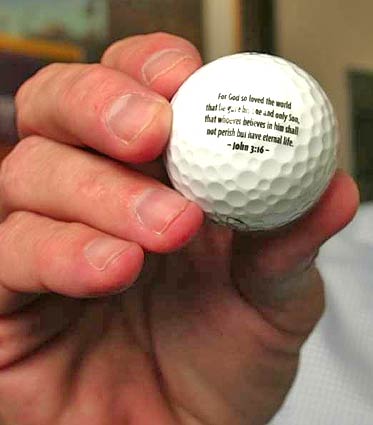
I know the print is small but that's John 3:16 on the golf ball to the right (photo by Mark Schiefelbein), one of the many items featured in this LA Times article about last week's International Christian Retail Show. (HT: Justin Taylor who was in attendance for the books).

Seeing that picture made me think that now is a fine time to show off some of my own evangelistic paraphernalia. A dear friend who knows of my fondness of such treasures, gave me the momento below. (It reads "I once was lost but now am found" on the other side.) He's commented that he checks the blog from time to time, to see if I've featured it. So, Karl, here it is!

Since I'm not a golfer and the ball never gets any green time, I suppose I could be charged with hiding my light under a bushel (or in this case, in my dresser drawer). But summer isn't over yet. Maybe I'll get the sandals that will allow me to leave footprints in the sand that read "Follow Jesus."

Art Behind Bars

Donny Johnson, serving three life terms in solitary confinement for murder and slashing a prison guard's throat, creates paintings using pigmentation from M&M's, blank postcards, and a paintbrush made, in part, from strands of his own hair.


Reading this story in the New York Times reminded me of Pascal's frequent commentary on humanity's simultaneous greatness and wretchedness. By virtue of creation we are bearers of the divine image, capable of creating astounding beauty. By virtue of the fall, our hearts are inclined toward performing great evil. On account of Christ's death and resurrection, those who trust him expectantly await the restoration of creation's glory and the ability to create moral and aesthetic beauty, unhindered by the bars of our present sinfulness.