Showing posts with label doctrine. Show all posts

Friday, June 20, 2008

An Ironic Side Effect of Toning Down Hard Truths

Here's something related to my previous post. Ligon Duncan points to the following thoughts from John Piper (he doesn't note the source) on how diluting biblical truth for the sake of winning unbelievers may actually harm the faith of those already in Christ:
. . . softening hard truth for evangelism in public undermines truth for the waffling believer in private. 
I think in general this is what cultural adapters fail to realize: making the truth more palatable for unbelievers to help them make a step toward orthodoxy serves even more (it seems historically) to help loosely orthodox people feel how unpalatable orthodoxy is and move away from it.

Saturday, March 01, 2008

Apologetics From the Pulpit

Well, not so much apologetics as in the defense of the faith as apologizing. Peter Mead has a great post about the false though prevalent dichotomy between practical and doctrinal preaching (HT: Milton Stanley). Peter relates the lament of a well-known seminary professor over visiting speakers who introduce their messages with comments about leaving theology to the faculty and wanting to be practical.


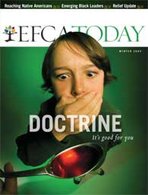
This has been a pet peeve of mine for some time. I can't count the number of pastors I've heard on the radio and in person who've timidly prefaced doctrinal expositions with an apology to the congregation as though the explanation of biblical theology is, at best, bitter medicine and, at worst, a necessary evil. Preachers don't regularly apologize for telling jokes and stories. Why, then, do we frequently feel compelled to beg our hearers' pardon for fulfilling the God-given mandate to "give instruction in sound doctrine" (Titus 1:9)?


Peter closes with this much-needed counsel to his peers:

Don’t give the impression that some sermons are biblical, exegetical, theological, doctrinal, while others are practical, pastoral, relevant and helpful. Strive to demonstrate that both sides are really on the same side - there really is no contest.

Wednesday, August 22, 2007

"Love the People, Destroy the Errors": The Imperative to Discern

We must be absolutely clear and unequivocal with this distinction between the person and the teaching. We must respect unconditionally the people whose views we critically analyze and respect their achievements on a human level. At the same time, we must oppose the mistaken theological view they have championed, in the hope that we may come to future agreement. In his dealings with schismatic bishops, St. Augustine followed this rule: Honor the person, fight the error. He laid down the polemical principle that we must content objectively with reasons and with proofs from Holy Scripture, and with the desire to win a person back, as he succeeded in doing in at least one instance. His motto was: Diligite homines, interficite errores; Love the people, and destroy the errors.

...the Christian community certainly has the privilege and task to evaluate what is being taught. Again, we may find both good and bad in someone's teaching. But we cannot play off one against the other; we cannot ignore the bad because of the good. It would be the same as excusing a pharmaceutical firm for a dangerous medicine because of the excellent penicillin preparations it has produced for years. It may go on producing excellent medicine, but production of the dangerous substance must be censured and stopped as well as restitution made. - Klaus Bockmuehl,
The Unreal God of Modern Theology (Helmers & Howard, 1988), pp. 5,6

Thursday, April 26, 2007

Getting Meyered Down

A few weeks ago I asked someone to please explain why Joyce Meyer was selected to be one of the distinguished plenary speakers at the 2007 World Conference of the American Association of Christian Counselors (AACC) to be held in Nashville, Tennessee this summer. A friend's recent inquiry about my estimation of Mrs. Meyer's teaching prompted me to elaborate on the reason for my befuddlement.
First, let me state that my confusion about and objection to AACC's choice has nothing to do with the fact that Mrs. Meyer is not a formally trained, professional counselor (a number of the other plenary speakers are not either). I would be the last person to insist that formal psychological training is necessary for one to be an effective counselor. As one commenter pointed out, Meyer has written numerous books (many of them bestsellers) on emotional and mental issues that would certainly be of interest to those engaged in the ministry of counseling. The cause of my consternation is theological. I can't understand why an influential evangelical organization (AACC has a membership of nearly 50,000) with a vision of "want[ing] to serve the worldwide Christian church by helping it become more mature in Christ" and a commitment to historic Christian orthodoxy, would endorse someone who has consistently dispensed aberrant teaching including the unbiblical doctrine that Jesus' atoning work was only partially accomplished by his death on the cross and completed in hell where he continued to suffer on behalf of sinners (see the following articles from the Christian Research Institute, the Apologetic Index, and Personal Freedom Outreach for details).


As Meyer's evangelical audience has broadened, she has distanced herself from Word of Faith leaders like Kenneth Copeland and Kenneth Hagin. One would hope this is due to her having come to see the error of their teachings but a careful examination of her ministry's website leads me to believe that this dissociation is due more to savvy marketing than to any rejection of the erroneous tenets of Word of Faith theology.


Joyce Meyer Ministries tries to quell potential discomfort and/or suspicion on account of her Word of Faith ties with the inclusion of the following questions and responses in its FAQ's:
Is Joyce Meyer Ministries a "word of faith" ministry?
Joyce Meyer Ministries believes in the Word of God. Joyce teaches that God has made promises to us in His Word and as believers, we should trust His promises (see 2 Peter 1:3,4). However, it can be damaging when people place their faith in faith alone instead of placing their faith in God. Misappropriation of God’s promises solely for personal gain is not scripturally supported.
Does Joyce Meyer Ministries teach a "prosperity gospel"?
Joyce Meyer Ministries believes that God desires to bless His people. Joyce teaches that God’s blessings and prosperity apply to the spiritual, emotional, physical and financial areas of life. These blessings and prosperity are then to be used to bless others (see Genesis 12:1-3). A “prosperity gospel” that solely equates blessing with financial gain is out of balance and could damage a person’s walk with God.
Notice that in neither case does Meyer answer the question directly, allowing her to safeguard against alienating herself from either the Word of Faith audience with which she at one time more openly identified or mainstream evangelicals who would steer clear of anything that smacked of "name it and claim it" teaching. All she does is affirm belief in God's Word and promises, an affirmation with which every Christian (and many cultists) would agree. The critical issue is not whether Meyer believes that God has made promises in which we should place our confidence. It's whether what she believes the Word of God says is consonant with Word of Faith teaching in which case it is discordant with biblical teaching.


Meyer's caution against placing faith in faith instead of in God is hard to make sense of in light of her practice and advocacy of "positive confession." Linked to from her ministry's website is a list of confessions Meyer developed and began confessing over her life in the early 1980s. The following are some of the more interesting of the seventy affirmations with my comments in parentheses:
I love all people, and I am loved by all people. (cf. Luke 21:17)

All my children have lots of Christian friends, and God has set aside a Christian wife or husband for each of them.
I take good care of my body. I eat right, I look good, I feel good, and I weigh what God wants me to weigh.
I operate in all the gifts of the Holy Spirit, which are tongues and interpretation of tongues, the working of miracles, discerning of spirits, the word of faith, the word of knowledge, the word of wisdom, healings, and prophecy. (Aside from the fact that the apostle Paul teaches that no believer possesses every spiritual gift (1 Cor. 12: 4ff), the omission of what Paul identifies as a higher gift is interesting in light of the following confession.)
I am a teacher of the Word.
I know God's voice, and I always obey what He tells me.
My car is paid for.
I am rich - very rich.
I receive speaking engagements in person, by phone, and/or by mail every day.
We have all the new furniture we need. We have a new car.
More on the power of positive confessions can be found in Meyer's commentary on "healing Scriptures" and her brief article "God's Prescription for a Sound Mind" in which she advises: "As you recognize a lie to your mind, always defend yourself out loud. That means speaking to Satan and the evil forces out loud, binding them in the Name of Jesus, and forbidding them to lie to you and to use your mind" (emphasis hers).
In an excellent article titled "Those Know-Nothing Christians," Michael Spencer describes and seeks to account for a widespread phenomenon in American evangelicalism - the desire on the part of high-profile Christian leaders to be as doctrinally nondescript as possible so as to achieve what Spencer calls "doctrinal invisibility." As he puts it:
Contemporary Christians want to go high-profile in every conceivable way except in saying what they believe. In doctrinal matters, the best most can do is a kind of generic "Jesus is Lord-ism," and the worst is to declare war on confessional Christians as divisive bigots harming the Body of Christ and driving away seekers.
Spencer identifies three contributing factors to doctrinal invisibility, among them - commercial interests. His comments on this point are relevant to the subject of this post:
Take, for example, the Christian publishing empires. A successful author such as Joyce Meyer now crosses any and all confessional lines and is marketed as a generic evangelical. Her books are as palatable to Pentecostals and Baptists as they are to Charismatic Catholics. The fact that Mrs. Meyer is a member in good standing of the Word-Faith movement of Kenneth Copeland and Kenneth Hagin is not going to be emphasized. The day when a Word-Faith teacher would be unwelcome in a Baptist church are gone. Mrs. Meyer, who has many commendable applications of scripture, gives no evidence in her popular books of a specific commitment to anything other than the most generic kind of Christianity. One will read all her books without finding that Mrs. Meyer holds loyally to the bizarre views of Hagin and Copeland.
Such doctrinal invisibility is on purpose. The editors and publishers of the thousands of books Meyer sells will make sure that no hint of her own specific Word-Faith doctrines appear on to those pages. While there are some publishers that exist to present specific doctrinal points of view, the largest and most influential Christian commercial interests are the most skillful practitioners of doctrinal invisibility.
Perhaps Joyce Meyer speaking at the AACC conference is a testimony to the effectiveness of the kind of doctrinal camouflaging Spencer describes. I'd prefer to think the invitation was extended because of ignorance of her theological leanings rather than with full knowledge (though that raises other questions about the care taken in selecting speakers). Whatever the case, it's lamentable that the AACC is commending her to pastors, lay counselors and clinical professionals called to serve a church sorely lacking in biblical discernment.

Thursday, April 12, 2007

"It Begins in the Mind"

This week's Kairos Journal update includes the following quote from A. W. Tozer on the origin and progression of idolatry:
Let us beware lest we in our pride accept the erroneous notion that idolatry consists only in kneeling before visible objects of adoration, and that civilized peoples are therefore free from it. The essence of idolatry is the entertainment of thoughts about God that are unworthy of Him. It begins in the mind and may be present where no overt act of worship has taken place. “When they knew God,” wrote Paul, “they glorified him not as God, neither were thankful; but became vain in their imaginations, and their foolish heart was darkened.”
Then followed the worship of idols fashioned after the likeness of men and birds and beasts and creeping things. But this series of degrading acts began in the mind. Wrong ideas about God are not only the fountain from which the polluted waters of idolatry flow; they are themselves idolatrous. The idolater simply imagines things about God and acts as if they were true.
Perverted notions about God soon rot the religion in which they appear. The long career of Israel demonstrates this clearly enough, and the history of the Church confirms it. So necessary to the Church is a lofty concept of God that when that concept in any measure declines, the Church with her worship and her moral standards declines along with it. The first step down for any church is taken when it surrenders its high opinion of God. - A. W. Tozer, The Knowledge of the Holy (San Francisco: HaperCollins, 1961), 3-4.

Thursday, September 14, 2006

Lee Eclov on the Dangers of Practical Preaching

Everyone who preaches or listens to sermons should check out an excellent two-part article by Lee Eclov recently posted at Out of Ur. Lee takes on two popular misconceptions about biblical preaching: The Bottom Line Fallacy and the Practical Fallacy. Both, he says, demonstrate misunderstanding not only about preaching but how Scripture works:

The Bible spends much more time on shaping the spiritual mind than commanding particular behavior. We need far more training in the ways of grace, of spiritual perceptions, and of what God is really like, than we do in how to communicate with our spouse. Understanding the glory of Christ is far more practical than our listeners imagine. Properly preached, every sermon based on a passage of Scripture is fundamentally practical. Every author of Scripture wrote to effect change in God's people. It is our job as preachers to find the persuasive logic of that author and put that clearly and persuasively before our people through biblical exposition.
Thank you, Lee!

Wednesday, August 09, 2006

Reuniting Theology and Life

I recently started reading Redeeming the Routines: Bringing Theology to Life by Robert Banks. In it, he addresses the need to help Christians close the gap that frequently exists between their professed beliefs and their every day activities (e.g., homemaking, study, employment, leisure, etc.). We often hear about how the Christian faith is relevant to all dimensions of life but aside from admonitions to be morally upright in whatever we're doing, little of the church's disciple-making efforts is devoted to aiding believers to think Christianly about their specific stations in life. Banks illustrates this deficit with the following illustration:
Now if you ask a representative sample of Christians whether faith and life ought to be in harmony, they will answer a resounding "yes." The rub comes when you put the question in a specific way, in relation to a particular aspect of work or area of responsibility. For example, if you are a homemaker and I ask you whether your religious convictions should influence the way you bring up your family and relate to your neighbors, you will probably nod your head in agreement.

But then if I ask you whether those convictions have as clear and direct an influence on the kind of house you have, area you live in, and the means of commuting you use, you will probably pause to think. Unfortunately, we are unaware how much our decisions in these areas are molded by broader social attitudes and have little distinctively Christian about them.
I think Banks's observation is accurate. It is far easier for us to deal with general principles than it is to invest the time and mental energy required to ponder which biblical truths are pertinent to specific situations and how. I just finished a chapter called "The Credibility Gap" in which Banks offers ten theses, half of which explore the gap many Christians recognize between their faith and their routines. The other five deal with the gap between how theology is customarily written/taught and everyday life. It is this half that I found most interesting, especially what he has to say related to the following thesis: "Our everyday concerns receive little attention in the church."

After stating that many Christians regard sermons and church activities as "otherworldly" (in the negative sense) and unrelated to their mundane patterns of life, Banks says this:

Most Bible studies are of little help here. They tend to concentrate on the exposition of biblical books or on the discussion of theological themes. Obviously these are basic concerns, but why is so little attention paid to the proverbial passages in the Bible or to the lives of some of the ordinary figures who feature in it? Doctrinal topics or broader social and political questions, perfectly valid in themselves, tend to squeeze out more everyday concerns in study groups. Even work-based Bible studies and study groups rarely address the specific questions, dilemmas, pressures, and aspirations that arise in the employment situation. In fact, the concentration upon pure Bible study in some of these groups is often an escape from grappling with the real issues of life.
That last sentence really caught my attention. We can use even the Word of Truth to shield ourselves from facing reality. We can treat theology like a sanctified narcotic by which we seek to flee life's pain and discomfort - not only our own but that of others. Remaining at the level of abstraction can keep me at a safe distance from the particulars of another's misery.

In case anyone's wondering, here are all ten theses Banks presents in this chapter:

  1. Few of us apply or know how to apply our belief to our work, or lack of work.
  2. We make only minimal connections between our faith and our spare time activities
  3. We have little sense of a Christian approach to regular activities.
  4. Our everyday attitudes are partly shaped by the dominant values of our society.
  5. Many of our spiritual difficulties stem from the daily pressures we experience.
  6. Our everyday concerns receive little attention in the church.
  7. Only occasionally do professional theologians address routine activities.
  8. When addressed, everyday issues tend to be approached too theoretically.
  9. Only a minority of Christians read religious books or attend theological courses.
  10. Most churchgoers reject the idea of a gap between their beliefs and their ways of life.
Related Tags: , , , , , ,

Saturday, May 27, 2006

Kevin Vanhoozer Talks about The Drama of Doctrine

I was glad to see that two recipients of Christianity Today's 2006 Book Awards are projects of Dr. Kevin Vanhoozer of Trinity Evangelical Divinity School. He's the general editor of the Dictionary for the Theological Interpretation of the Bible and author of The Drama of Doctrine: A Canonical-Linguistic Approach to Christian Theology (about which I've written here and here).

The current issue of Trinity Magazine, a publication of Trinity International University, contains an interview with Vanhoozer about The Drama of Doctrine. Here are some select quotes that demonstrate why this volume is deserving of CT's recognition and evangelicals' attention.

Doctrine is dramatic precisely because it is about real life, namely, the way of truth and life identified with Jesus Christ. It's all about equipping the people of God to walk the way of Jesus Christ in the real world, a world that is complex and confusing. If theology is to serve the church, what it produces - doctrines - should help us understand not only the past but also our present.


Theology is 'faith seeking understanding' (Anselm), but understanding is not merely theoretical. We demonstrate our understanding only when we show that we know how to live as disciples of Jesus Christ, people who know how to embody the truth of the gospel in diverse settings and situations. Doctrine is dramatic when it aids and abets lived understanding.


Christianity is essentially about dramatic action, about what God has done in the history of Israel and especially in the person and work of Jesus Christ for the salvation of the world. Drama means 'doing,' and the Bible is all about the 'doings' of the triune God: Father, Son, and Spirit. Speaking is a form of doing, too; the action in some plays is largely dialogical. In Scripture, God gets the most important speaking and acting parts.


Doctrine directs disciples to act, yes, but to act not as hypocrites but according to their true natures and in accordance with the way things really are in Christ. Doctrine tells us not how to pretend to be something that we are not, but rather who we really are; the vanguard of a new creation. Doctrine defines me as a creature of God made in his image and as an adopted child into God's family. My true identity is ultimately a matter of my union with Christ. All other identity-markings-political affiliation, class, race, even gender-while important, are ultimately only secondary.


[T]he imagination enables us to see the parts of the Bible as forming a meaningful whole. But we can go further still. The imagination also enables us to see our lives a part of that same meaningful whole. This is absolutely crucial. Christians don't need more information about the Bible, trivial or otherwise. What the church needs today is the ability to indwell or inhabit the text, the ability to make the Bible serve as the framework through which we interpret God, the world, and ourselves.


I think a picture of doctrine as theoretical information has held evangelicals captive for too long. We believe the right things and sign on the dotted line of our confessional statements, but too many of us are unable to relate our official theology to everyday life. There is a tremendous disconnect. We know how to profess, but not to practice, the cross.


Most evangelical textbooks view doctrine in terms of teaching or of factual propositions. Liberal theologians tend to see doctrine as an expression of religious experience. So called 'postliberals' have recently suggested that doctrines are like grammatical rules that describe Christian talk and Christian action. My own view is that doctrine is a matter of dramatic direction, direction for understanding and participating in the gospel action. In other words, doctrine gives us guidance for our new life 'in Christ.' What you have to remember is that understanding is not merely theoretical: Christians have not only to know but to do the truth.

Tuesday, December 13, 2005

Wednesday, September 21, 2005

Thoughtful Praise

Christians are sometimes leery of theological learning for fear that such efforts run the risk of divesting the faith of mystery. But that need not be the case. If anything, our sense of mystery should be enlarged by our study. C. H. Spurgeon eloquently conveyed this in a sermon on Malachi 3:6:

There is something exceedingly improving to the mind in a contemplation of the Divinity. It is a subject so vast, that all our thoughts are lost in its immensity; so deep, that our pride is drowned in its infinity. Other subjects we can comprehend and grapple with; in them we feel a kind of self-content, and go on our way with the thought, "Behold I am wise." But when we come to this master science, finding that our plumb-line cannot sound its depth, amid that our eagle eye cannot see its height, we turn away with the thought "I am but of yesterday and know nothing."
Theology, properly pursued, should not only inform our intellects but shape our characters. In other words, it should nurture Christian virtues. Every encounter with material that requires me to mentally reach beyond the level to which I'm accustomed and with which I'm comfortable, is an opportunity to practice patience, perseverance, and self-denial. Taking the time to read and reread something that I initially find confusing and/or irrelevant to my immediate concerns can teach me something of what it means to listen attentively to another in love, not insisting that everything revolve around my concerns. And, as Spurgeon reminds us, far from breeding arrogance, our growth in the knowledge of God should strike us with the awareness of how little we really know.

Related to that point is one that Reformation 21's Richard Phillips made recently about the relationship between the Christian worldview and wonder:
One of the best things about the Christian worldview is that it opens the door to wonder. The reason is that Christianity contains something greater than bare cause-and-effect. Ours is a worldview without a roof, so it not only has room for mystery and glory but it constantly points us towards these wonderful things. It is said that the longer Darwin lived, the less taste he had for music, poetry, and literature. His worldview made his life smaller and smaller. But the Christian can and should see wonder in all things. From something as simple as a leaf, to the baby's cry, to the crashing cosmos, Christians should constantly exclaim in wonder, "O Lord, our Lord, how majestic is thy name in all the earth!"
If our theology does not evoke praise, we have not gone far enough.

Friday, September 09, 2005

Vanhoozer on Doctrine, Life, and the Mind of Christ

Last week I mentioned Kevin Vanhoozer's new book, The Drama of Doctrine, in which he proposes a model of theology that relies heavily on the dramatic arts. The English word "drama" is derived from the Greek word drao which means "I do." A drama is a series of doings both dialogical and physical. It is also characterized by entrances and exits by the cast members. "Dramatic" is an appropriate description for redemptive history because in it God interacts with humanity through speech and actions (as well as through speech-acts, the foremost of which is Jesus Christ). The Bible is not only a record of God's historic acts, however. It is a player in the ongoing drama:

The basic insight is that the Bible is not simply a deposit of revelation but one of God's "mighty acts" -- a mighty communicative act, to be exact. Scripture has a role -- a speaking, acting part -- in the drama of redemption precisely as divine discourse. Scripture not only conveys the content of the gospel but is itself caught up in the economy of the gospel, as the means by which God draws others into his communicative action. Jesus is God's definitive Word, to be sure, but Scripture projects his voice and extends his action (48, here and in following quotations, emphasis is in the original).
Scripture, according to this understanding of redemptive history is far more than source material for building theological systems. It is a script intended to direct the life of the church. If theology is to be consonant with the dramatic nature of its subject matter, it cannot be satisfied with merely repeating doctrinal formulations from the past or with mental apprehension of biblical truth:
The script exists for the sake of speeding the drama of redemption. The ultimate purpose of the divine canonical discourse is to form a new people, the vanguard of a new creation. This is the "perlocutionary" [According to speech-act theory, the perlocution is the effect produced by saying something. This is in distinction from the illocution, the act performed in saying something] purpose of Scripture, its intended effect. Dramas are not devised primarily to convey information but to move us, to persuade us, to delight us, to purge us of unwanted feelings (182).
It's not that intellectual understanding is of no value. As Vanhoozer points out, actors must understand a script in order to render a faithful performance. Understanding, then, is displayed not solely by the ability to repeat the lines, but to live our parts. This requires more than rote recitation of lines and mechanical acting which amount to hypocrisy. Vanhoozer believes that the famed acting teacher and director Constantin Stanislavski has something to teach us. According to Stanislavski's system for learning how to act (referred to as "the Method"), an actor must become his or her role. This encompasses the use of the intellect, yes, but other cognitive factors as well. "What doctrine [understood as theo-dramatic direction] communicates --its 'import'--involves the whole person: cognition, affection, and volition alike" (100).

Many of us bemoan the anti-intellectualism that characterizes much of contemporary evangelicalism. (One of my own pet peeves is that it seems that whenever we sing "Take My Life and Let it Be," we skip the verse that reads "Take my intellect and use, every pow'r as Thou shalt choose.") I think there is due cause for lament. However, I know I have to guard myself against overcompensating such that I neglect the other dimensions of my humanity with which I am to love, enjoy, and serve the living God. Talk about developing a "Christian mind" can easily lead us to think in exclusively intellectual terms. That's why I especially appreciated the following description of theology's ultimate goal according to Vanhoozer's conception:
Canonical-linguistic theology is not simply a hermeneutic, a way of dealing with the text, but a way of life: a scripted and spirited performance, a way of wisdom generated and sustained by word and Spirit. As such, it is as concerned with training performers as it is with understanding the script. Its intent is not merely to inform but to transform minds. Canonical-linguistic theology represents a kind of cognitive therapy that aims to replace distorted patterns of thinking with patterns that correspond to canonical practices, to theo-dramatic reality, and, ultimately, to the mind of Christ

The "mind of Christ" refers not merely to Jesus' intellectual quotient or his stock of knowledge but to his habitus: the distinctive pattern of all his intentional acts--desires, hopes beliefs, volitions, emotions, as well as thoughts. The mind of Christ refers, in a word, to the characteristic pattern of Jesus' judgments--to the way that Jesus processes information and to the product of that process: the embodied wisdom of God. The mind of Christ is the set of moral, intellectual, and spiritual habits or virtues that serve as the mainspring for all the particular things that Jesus does and says (255-256).
In the introduction, Vanhoozer writes, "The hoped-for outcome of canonical-linguistic theology is nothing less than the missing link between right belief (orthodoxy) and wise practice (orthopraxis): right judgment (orthokrisis)" (30).

I am weary of doctrinal debate and discussion that seems to hang in the air, detached from life. That's why I find Vanhoozer's vision so refreshing. There are exceptions, of course, but it seems to me that many of us who are rightly concerned about doctrinal precision are more comfortable in the realm of abstraction and in need of connecting the doctrines we defend and love to the lives we live. Truth, after all, is not only to be known, but practiced.

Wednesday, August 31, 2005

The Drama of Doctrine

So what have I been doing with the time I haven't blogged? I've been wearing my pencil lead out underlining and making notes in a volume that Scot McKnight has already declared "the best book on Scripture for the new century" - Kevin Vanhoozer's The Drama of Doctrine: A Canonical Linguistic Approach to Christian Theology. Vanhoozer makes a compelling case that theatrical drama provides a helpful model for conceiving of the nature of Scripture, theology, doctrine, and Christian life. Following N. T. Wright's division of redemptive history into a drama of five "acts," Vanhoozer says that the canonical texts compose an authoritative script that not only recounts the "theo-dramatic" action of the past but also serves as a means by which God is still acting, calling people to participate in the theo-drama and directing the performance of the church which lives between Acts IV and V. He writes in the book's preface:

This book sets forth new metaphors for theology (dramaturgy), Scripture (the script), theological understanding (performance), the church (the company), and the pastor (director). It argues that doctrine, far from being unrelated to life, serves the church by directing its members in the project of wise living, to the glory of God. It sets out to convince ministers and laypeople alike not to dismiss doctrine as irrelevant, and to encourage theologians not to neglect the needs of the church. It aims to make the pastoral lamb lie down with the theological lion. Its goal is to refute, once and for all, the all-too-common dichotomy between doctrine and real life. Christian doctrine directs us in the way of truth and life and is therefore no less than a prescription for reality (xii).
The rift between so-called "academic" and "practical" theology has long been a burr under my saddle so to say that I'm enthusiastic about this kind of thinking is a gross understatement. In the paragraph preceding the one I just quoted, Vanhoozer states that doctrine is vital to the church's well-being and witness. "The problem," he writes, "is not with doctrine per se but with a picture of doctrine, or perhaps several pictures, that have held us captive." What he has in mind is the picture of the Bible as a deposit of revealed truths or assertions about states of affairs. According to this view, theology's primary goal is to abstract and arrange these propositions in a logically consistent system. But this is flawed for a number of reasons. First, this approach is reductionistic in that it recognizes only one of the many things that authors and speakers do with words. Referring or informing is only one of language's many uses. God does more in and through the Bible than impart information. He promises, commands, warns, comforts, etc. Scripture is revelatory, but is more than revelation. Privileging assertions over other linguistic practices entices us to focus on the intellect at the expense of our other faculties and on theorizing at the expense of practice.

Propositionalism also runs roughshod over the variety of canonical literary forms:

The main defect of propositionalism is that it reduces the variety of speech actions in the canon to one type: the assertion. This results in a monologic conception of theology, and of truth. To think of theology as a monologue, even a truthful monologue, is to reduce theo-drama -- in which the dialogical action is carried by a number of voices -- to mere theory. Neither the theo-drama nor the canonical script can be reduced to propositions and theories without significant loss. Doing justice to the biblical text ultimately requires a different kind of exegetical scientia, one that goes beyond propositionalism without, however, leaving propositions behind (266).
Vanhoozer, then, is not denying the propositional content of Scripture. He's simply calling us to recognize that there is more than meets the eye (and the heart) than assertions. He proposes a postpropositionalist hermeneutic where the prefix post- means "beyond," not "against." Faithful interpretation, according to Vanhoozer's proposal model, is not merely a matter of sound exegesis and conceptualizing. Conceiving of the Bible as script means that our understanding of it is ultimately demonstrated by our following its direction in contemporary situations:

"Faith seeking understanding" involves both coming to appreciate the meaning of the script and knowing how to perform it in new contexts. Hence theology is both an exegetical scientia [disciplined knowledge] that is faithful to the canonical text and a practical sapientia [practical wisdom] that is fitting to the present cultural context. The ultimate goal of theology is to foster creative understanding -- the ability to improvise what to say and do as disciples of Jesus Christ in ways that are at once faithful yet fitting to their subject matter and setting. The church continues to perform the same text in different contexts, despite the difference of centuries, cultures, and conceptual schemes, by "improvising" with a canonical script (32).
Reading The Drama of Doctrine reminds me of another passage I marked in another sizable tome -- Calvin's Institutes:
Doctrine is not an affair of the tongue, but of the life; is not apprehended by the intellect and memory merely, like other branches of learning; but is received only when it possesses the whole soul, and finds its seat and habitation in the inmost recesses of the heart....To doctrine in which our religion is contained, we have given the first place, since by it our salvation commences; but it must be transfused into the breast, and pass into the conduct, and so transform us into itself, as not to prove unfruitful (III. VI. 4.).
Don't let the cost or mass of this book stand in the way of your reading it. It's worth the price and physical exercise is good for you.

Lord willing, tomorrow I'll be attending a discussion Dr. Vanhoozer will be leading for pastors and church planters, sponsored by the Great Lakes District Church Planting Office of the Evangelical Free Church. I'm looking forward to hearing more about how he envisions his model of theology playing out in pastoral ministry. If you're in the area of Trinity Evangelical Divinity School, the event will be held in A. T. Olson Chapel between 3 and 5 p.m.