Monday, January 15, 2007

Breakfast Links

Justin Taylor interviews Thomas Schreiner about Believer's Baptism: Sign of the New Covenant in Christ, the new book he co-edited with Shawn Wright. Add another title to my "to read" list.

Out of Ur previews an upcoming Leadership Journal article by Tim Conder on the missional church. Conder wonders if "missional" has become the new evangelical buzzword and provides a helpful list of characteristics shared by those churches that identify themselves as such.

Al Mohler is thankful beyond words to all who prayed for him during his hospitalization. It's good to know he's recovering at home.

When I got my copy of Paul Tripp's and Tim Lane's new book, How People Change, I didn't recognize its publisher - New Growth Press. If you'd like to know more about the official publisher of CCEF's literature, read this. (HT: Michael DiMarco)

PS at Burn the Ships points to a video of Barbara Walters interviewing Joel Osteen that helps explain why the smiling preacher topped the Church Report's recent list of the 50 most influential Christians in America.

Related Tags: , , , , , , , , , ,

Saturday, January 13, 2007

Quentin Schultze on Using Technology Wisely

Last November the Carl F. H. Henry Center for Theological Understanding hosted Dr. Quentin Schultze as part of its Scripture and Ministry Lecture Series. His topic was "Beyond the Digital Rat Race: Using Technology Wisely in Our Lives, Work, and Churches." I had the pleasure of attending and encourage those who didn't to make prudent use of their computers by listening to the audio [download].

Wednesday, January 10, 2007

The New Prozac Nation: Psychiatry Gone to the Dogs

From the L.A. Times:
THEY are the new "Prozac Nation": cats, dogs, birds, horses and an assortment of zoo animals whose behavior has been changed, whose anxieties and fears have been quelled and whose owners' furniture has been spared by the use of antidepressants. Over the last decade, Prozac, Buspar, Amitriptyline, Clomicalm — clomipromine that is marketed expressly for dogs — and other drugs have been used to treat inappropriate, destructive and self-injuring behavior in animals.


It's not a big nation yet. But "over the past five years, use has gone up quite a bit," said veterinarian Richard Martin of the Brentwood Pet Clinic in West Los Angeles. Half a decade ago, no more than 1% of his patients were on antidepressants. Now, Martin estimates that 5% of the 8,000 cats and dogs seen at the clinic are taking drugs for their behavior.
Speaking of canines, I can just see the pharmaceutical companies salivating like Pavlov's dog over this news. Americans have consistently proven that we'll spare no expense for the furry members of our families so the potential income from pet mental health is beyond imagination. I predict that Prozac Puppy Chow is on the horizon. What I want to know is if suicide rates increase among household pets, will PETA intervene?

I couldn't help noticing that the psychiatric treatment of four-legged creatures is superior to that of many of their human counterparts. The article cites one veterinarian who says that dogs are not intended to stay on antidepressants for life. "We don't have specific studies on long-term use." The article goes on to say that most vets prefer to taper their patients' use of the drugs. "We try to use these medications short-term," says another veterinarian, "because they are not without side-effects." If only more physicians exercised the same caution. I'm sure human physiology isn't any better suited to endure sustained treatment with brain-altering medication and, given the fact that the popular class of antidepressants known as selective seorotonin reuptake inhibitors only appeared on the scene in the late 1980's, we have yet to discover what adverse effects accompany long-term use.

In Recognition of Atheist Appreciation Week

Joe Carter has declared this Atheist Appreciation Week and is honoring the occasion with daily posts (start here) on his "favorite bizarre worldview."

I just started reading Richard Dawkins' The God Delusion and now there's question as to whether he even exists! (HT: Tom Gilson)

Religion & Ethics NewsWeekly recently did a story on the "new atheists." Read the transcript and/or view the segment here.

The Christian Science Monitor reports on how atheists are challenging the religious right.

Finally, as my own token of appreciation, below, I'm recycling one of my posts from two years ago called "I Believe in Matter Almighty."


******************

World Magazine's Marvin Olasky interviewed Alvin J. Schmidt, author of How Christianity Changed the World (originally published as Under the Influence). Responding to the question of how Christians can counter the widely held belief that Christianity and science are incompatible Schmidt says:

Alfred North Whitehead (a non-Christian philosopher of science) said that without Christianity's "insistence on the rationality of God" there would be no science. The first experimental scientists, beginning with the 13th century, were all confessing Christians (Roger Bacon, Occam, Francis Bacon, Kepler, Boyle, Simpson, Pasteur, etc.). They related their scientific findings to biblical theology. Not until the 18th century, when many scientists bowed to philosophical materialism, were Christianity and science defined as incompatible.
If Christians don't understand how to identify and refute the materialistic faith that underlies much of what goes by the name of science, we'll be running down a myriad of rabbit trails, arguing over particulars while overlooking core worldview considerations. As Phillip Johnson observes in The Right Question: Truth, Meaning & Public Debate: "Christians often think the controversy is primarily a dispute about scientific facts, and so they become trapped into arguing scientific details rather than concentrating on the fundamental assumptions that generate the evolutionary story."

Surprisingly, many adherents to the materialistic faith are ignorant of their faith commitments. They claim to be just following the facts wherever they lead, unencumbered by philosophical precommitments. This is why Cornelius Van Til insisted that one of the primary tasks of apologetics is to make unbelievers "epistemologically self-conscious," that is, aware of their own presuppositions about the nature and extent of knowledge.

The following online exchange with a self-professed "scientific materialist" (SM) illustrates the "faith" of a materialist at work:

KP: I've been thinking...although you say that you and other scientific materialists would willingly alter your position given enough counter evidence or the inability (in principle) of naturalism to account for observed phenomenon, haven't you really posed the issue in such a manner that it is practically unfalsifiable? I mean, at times you appeal to what you believe is evidence in favor of your position but when faced with information that appears to counter it, you can always retreat to the claim that a naturalistic, though currently unknown, explanation exists.

SM: I don't think so. Science has undergone some remarkable changes in thinking...from the Newtonian universe to the Einsteinian, for example...Paradigms change in response to an accumulation of evidence that cannot be explained under the present system, and which points to phenomenon outside the present knowledge.

KP: But again, I'm speaking specifically of the naturalistic presupposition. I still maintain that that is the most strongly held belief of contemporary science. I'm not denying that there are in the field of science. 

SM: Because there's nothing that has yet been unexplainable. I am not going to give up a system that works very well all over the place lightly or happily and certainly not unless there is positive evidence that falsifies it, or at least that points clearly to things beyond the paradigm. I think most scientists do indeed make naturalistic assumptions although the trend towards theories of information, complexity, and so forth makes the assumptions of today much less mechanistic and much less reductionist then has been the case in the past.

KP: You sometimes speak as though science and Christianity are incompatible. Why is that? I fail to see what it is about the Christian worldview that would make the scientific enterprise impossible. Science would "work" just as well under a Christian theistic framework.

SM: That's true. And that's why many scientists are able to maintain religious beliefs, often strongly held and sincere, from what I can see. The scientific method can be applied at work, without falsifying one's commitment to Christianity.

KP: Then it's kind of misleading to speak as though science only works well or even best with naturalistic assumptions.

SM: Ah...but one must make the assumptions of science in one's work, otherwise, one is doing something other then science. But science does not entail a set of ultimate commitments. Certainly, it does not need to. Anyone who can apply the standards and methods of their particular field can practice science. And, if they wish to have religious beliefs beyond that, I see no problem there. If religious beliefs determine the science, well, that is a problem.

KP: And is it a problem if science makes religious/theological assertions? And what do you mean by "the assumptions of science"? Is naturalism a necessary assumption for the application of the scientific method?

SM: If you make supernatural assumptions about things, your work won't go very far in modern science. What a person believes in their private, personal life is irrelevant to their science so long as it conforms to the standards of their field. If it does not, then their work will need to be good enough to overthrow the dominant paradigms or they will not get far.

KP: No doubt about that. If one adheres to a supernatural worldview, he/she won't go far in modern science because of the naturalistic bias. Those who are vocal about their religious convictions are ostracized as pseudo-scientists. There is an "in-house" pressure to conform to scientific materialism but this says nothing about the truth of that position. You see, what you're saying? You're saying that religion is to be privatized but has no bearing on anything beyond the subjective experience of the one who holds to a particular faith. 

SM: The difference between science and other fields of study is that science checks itself against an objective/physical reality which actually exists. The option to ignore someone because you do not like his views (i.e. if he is religiously inclined) is limited by the "reality check" function. If someone's science is good, it will win out...not necessarily at once, but it will win out in the end.

KP: I really don't understand you. You talk about this objective reality as though there is no interpretation involved on the part of those doing the observing. The naturalistic viewpoint is not the result of scientific inquiry unless of course one assumes it prior to making his observations. We're talking about the philosophical, non-empirically verified, assumptions that we bring to our experiences. Mind you, I'm not denying that there is an objective reality that exists apart from our minds. What I am saying is that this reality check you speak of seems to overlook the philosophical dimensions I'm speaking of.

SM: Science is not about ultimate commitments. It's a practical and opportunistic attempt to make descriptions and models of the world. I don't think practicing scientists worry much about the ultimate assumptions of science. The scientific method is really a method - a collection of methods, even and certainly not something to be seen as timeless truth.

KP: And again, your saying that science is different from all other disciplines in that it is referring to an objective reality is to again assume materialism, not conclude it. You assume that the ethicist is not dealing with an objective standard of ethics and that the theologian is not dealing with an objective reality because they are not dealing with physical entities.
That scientists may be unconscious about their ultimate commitments, is really "immaterial" (pun intended). The fact is that they have them and they make pronouncements about them that are received authoritatively. Sagan's comment that the cosmos is all that exists, all that ever existed, and all that will ever exist is not a scientific statement but a philosophical/religious one.

SM: That is definitely a philosophical comment on Sagan's part, perhaps an aesthetic observation even. Sagan was quite a romantic, and a bit of a dreamer. Many scientists are, in some sense. Physicists seem almost addicted to romanticizing their subject.

KP: Your original comment was not that science tests physical objects but rather that what distinguishes it from other studies is that it has an "objective reality" to check against. Do you see that you assume that objective reality = physical existence and physical existence alone? And that is not a scientific conclusion but an a priori.

SM: That's what distinguished it. Where is the physical or external reality against which ethics might check itself? Theology...metaphysics....I do think that the difference between such systems of knowing and scientific knowing is exactly that ability to check against a physical world which exists in and of itself. Whether there's a non-material "reality" somewhere is...well....it does not seem a useful postulate to me.
But we have already established that assumptions must be made before any investigation of any sort...certainly as true of theology, ethics, sociology, as it is of science. Perhaps...science simply concerns itself with things that can be checked against external physical reality?

KP: And are the assumptions of science themselves known scientifically?

SM: I would say that every time an airplane is able to take off the ground, the "materialist/naturalist" assumptions that went into designing that airplane are validated just a little bit more.

KP: And a theist could not have discovered and applied the laws of physics and aerodynamics without adopting a naturalistic worldview?

SM: I suspect a theist could have done so, but only up to a point. A theist, depending of the type of theistic beliefs we are talking about, would have no necessary reason to go beyond theistic assumptions about how nature works. As science has advanced, it has progressed towards greater and greater tendency to explain natural phenomenon in natural terms.

KP: Modern science was founded upon theistic presuppositions. Does that, according to your reasoning, validate theism?

SM: In fact, much of physics has been developed by theists, certainly classical physics. Modern science has been successful largely to the degree that it abandoned theistic assumption. Science was founded by theists but it was founded by people who looked to nature to validate their hypotheses.

KP: You're not making a very good case here. Of course a theist would have reason to explore the working of nature. That is exactly why modern science was born in the context of Christianity.

SM: Science has been successful largely because it abandoned theistic explanations and substituted explanations of natural phenomenon in natural terms.

KP: And what theistic assumptions are threats to the progress of science? One doesn't have to presume naturalism to look to nature to verify claims about nature. The theist isn't bound to deny the validity of empirically derived knowledge, is he?

SM: The power of scientific explanation has grown in almost direct proportion to the degree that the role of "god" as a practical explanation has declined.

KP: And is it conclusive that that growth is due to the abandonment of theism or could it not be the result of time? One doesn't want to commit the post hoc ergo propter hoc fallacy.

SM: Conclusive? It is a pretty strong historical phenomenon. History does not generally provide "conclusive" proof of anything, but that doesn't at all mean that we can't understand what's going on. All history risks post hoc fallacies.

KP: Well, I think you're committing it now. You're saying that science has advanced BECAUSE theism has largely been abandoned and I don't think you can substantiate that claim. If what you are saying is true, we would not have expected science to have been founded by and flourishing among Christian theists.

SM: Really? How does theism yield knowledge of nature? If it's possible to invoke god at some point as an explanation, then why investigate at all? It seems to me that the history of science is a long and difficult attempt to overcome such thinking as applied to nature.

KP: Why investigate? Reformed theologians see the investigation and harnessing of nature as a fulfillment to the divine command to subdue the earth. Also, the classical theistic scientists set out to investigate the natural world because they believed that it was the product of a rational mind and therefore had an order to it. They also believed that we are created in the image of this God and therefore could, as Kepler said, "Think God's thoughts after Him". The idea that theism is somehow hostile to scientific inquiry is simply unsubstantiated.

SM: The association between declining use of theistic assumptions and rising explanatory power of scientific knowledge is clear. The matter of which is cause and which is effect, or whether there might be no association at all, is one of judgment, like most historical problems (at least those spanning such a long and complex period.) But is that not theism reflecting the influence of what are really non-theistic ways of seeing things? That's theism exhibiting some flexibility, which I certainly think is a good thing.

KP: You have consistently created a straw man of the theistic position and have sought to make Christian theism an enemy of real science. That's not so. Granted, there have been Christians who have been hostile to science but such a stance is in no way inherent within the Christian worldview. The Christian can only be said to be hostile to science unless one identifies science with naturalistic philosophy.

SM: If theism invokes supernatural explanations for natural phenomenon, I don't see how it can be accommodated in science.

KP: What non-theistic way of thought is that reflecting? 

SM: Any viewpoint that is bound up in revealed wisdom and absolute truth, which theism certainly is, is going to be very hard to reconcile with scientific exploration. The view that hypotheses should be checked against the world, and that when they conflict with revealed wisdom, revealed wisdom loses. I can't see the value of making supernatural assumptions about the universe. Where do such assumptions lead us? What kind of knowledge comes from them? How is it to be validated? That's pretty much all I'm saying.

KP: But why? You have yet to show any substantive conflict. And, as I've pointed out, if what you say is true, then science would have never been born in the bosom of Christianity. 

SM: I don't think I understand your point about the development of science from Christianity and I really don't think science was born in the bosom of Christianity at all. Seems to me that science came about despite massive and systematic resistance from orthodox Christian churches.

KP: This has been very stimulating and I appreciate your willingness to take this time with me. Right now, though, I have to go. I'd love to pick this up with you soon.

SM: OK...see you later. Have a good weekend, if i don't see you again.. : )

Saturday, January 06, 2007

Five(ish) Things I'd Like to Know About You

I'm honored to be among friends David Wayne tagged with a meme that made me do a lot of thinking. So, for David and anyone else who cares to read, here are my answers:

1) What's the most fun work you've ever done, and why? (two sentences max)
I worked for two years as a personnel specialist at an agency that provided home attendants to elderly and disabled clients. The work itself wasn't fun but my coworkers were some of the funniest people I've ever worked with.

2) A. Name one thing you did in the past that you no longer do but wish you did? (one sentence max)
Exercise regularly

B. Name one thing you've always wanted to do but keep putting it off? (one sentence max)
Learn how to fence.

3) A. What two things would you most like to learn or be better at, and why? (two sentences max)
I'd like to be better at writing freely. Composition is agonizing for me because I want to start with the finished process and avoid the editing process.
(I'm assuming the two sentence limit is for each answer)

I'd like to have a better understanding of music theory. I regret not taking it more seriously when, as a child, I took piano lessons.

B. If you could take a class/workshop/apprentice from anyone in the world living or dead, who would it be and what would you hope to learn? (two more sentences, max)
An apprenticeship in biblical counseling with David Powlison. I'd hope to learn how to better apply the gospel to my own life and help others do likewise.
4) A. What three words might your best friends or family use to describe you?
Intelligent
Reflective
Perfectionistic
B. Now list two more words you wish described you...
Disciplined
Patient
5) What are your top three passions? (can be current or past, work, hobbies, or causes-- three sentences max)
Theological education in the local church
Biblical Counseling
Reading

6) (sue me) Write--and answer--one more question that YOU would ask someone (with answer in three sentences max)
What other vocation can you see yourself in? Hosting an interview-format radio program dealing with issues of Christianity and culture. That would combine my love of conversation, the exchange of ideas, meeting people from various perspectives, and debate. Radio is a better medium than television for the serious discussion of ideas and their consequences.

[Bonus: What is one question you wish people would ask themselves?]
Why do I believe that?

Heeding Dave's request that I tag five friends, here goes:

Friday, January 05, 2007

Pray for Al Mohler

From his blog:

Dr. Mohler's health has sustained a setback. Over the past 36 hours Dr. Mohler has suffered from unrelenting pain. This unusual degree of pain signaled concern for the attending physicians and prompted additional tests this afternoon. In the past hour these tests have revealed that Dr. Mohler is suffering from pulmonary emboli in both lungs. His condition is quite serious and he has been moved to the intensive care unit of Baptist East Hospital in Louisville, KY for immediate treatment.


Please make this a matter of urgent prayer. Thank you once again for your concern and support during these days.

Update: Encouraging news from Russell Moore

Mere Mission

I hope the following excerpt from Tim Stafford's interview of N. T. Wright prompts you to read the rest:
For generations the church has been polarized between those who see the main task being the saving of souls for heaven and the nurturing of those souls through the valley of this dark world, on the one hand, and on the other hand those who see the task of improving the lot of human beings and the world, rescuing the poor from their misery.
The longer that I've gone on as a New Testament scholar and wrestled with what the early Christians were actually talking about, the more it's been borne in on me that that distinction is one that we modern Westerners bring to the text rather than finding in the text. Because the great emphasis in the New Testament is that the gospel is not how to escape the world; the gospel is that the crucified and risen Jesus is the Lord of the world. And that his death and Resurrection transform the world, and that transformation can happen to you. You, in turn, can be part of the transforming work. That draws together what we traditionally called evangelism, bringing people to the point where they come to know God in Christ for themselves, with working for God's kingdom on earth as it is in heaven. That has always been at the heart of the Lord's Prayer, and how we've managed for years to say the Lord's Prayer without realizing that Jesus really meant it is very curious. Our Western culture since the 18th century has made a virtue of separating out religion from real life, or faith from politics.When I lecture about this, people will pop up and say, "Surely Jesus said my kingdom is not of this world." And the answer is no, what Jesus said in John 18 is, "My kingdom is not from this world." That's ek tou kosmoutoutou. It's quite clear in the text that Jesus' kingdom doesn't start with this world. It isn't a worldly kingdom, but it is for this world. It's from somewhere else, but it's for this world.
Wright also addresses evangelism in a post-Christian age, the contemporary appeal of Gnosticism, and why our ideas about God must be shaped by New Testament Christology.

Modern Atheism: Old Arguments, New Tone

In a Wall Street Journal commentary, Sam Schulman, publishing director of the American, charges 21st century atheists with lacking the charm, sympathy, and depth of their tradition's forebears:
What is new about the new atheists? It's not their arguments. Spend as much time as you like with a pile of the recent anti-religion books, but you won't encounter a single point you didn't hear in your freshman dormitory. It's their tone that is novel. Belief, in their eyes, is not just misguided but contemptible, the product of provincial minds, the mark of people who need to be told how to think and how to vote--both of which, the new atheists assure us, they do in lockstep with the pope and Jerry Falwell.
For the new atheists, believing in God is a form of stupidity, which sets off their own intelligence. They write as if they were the first to discover that biblical miracles are improbable, that Parson Weems was a fabulist, that religion is full of superstition. They write as if great minds had never before wrestled with the big questions of creation, moral law and the contending versions of revealed truth. They argue as if these questions are easily answered by their own blunt materialism. Most of all, they assume that no intelligent, reflective person could ever defend religion rather than dismiss it. The reviewer of Dr. Dawkins's volume in a recent New York Review of Books noted his unwillingness to take theology seriously, a starting point for any considered debate over religion.
The faith that the new atheists describe is a simple-minded parody. It is impossible to see within it what might have preoccupied great artists and thinkers like Homer, Milton, Michelangelo, Newton and Spinoza--let alone Aquinas, Dr. Johnson, Kierkegaard, Goya, Cardinal Newman, Reinhold Niebuhr or, for that matter, Albert Einstein. But to pass over this deeper faith--the kind that engaged the great minds of Western history--is to diminish the loss of faith too. The new atheists are separated from the old by their shallowness.
An accurate description, I'd say.

Thursday, January 04, 2007

Awfully Good

"God is the only comfort, He is also the supreme terror: the thing we most need and the thing we most want to hide from. He is our only possible ally, and we have made ourselves His enemies. Some people talk as if meeting the gaze of absolute goodness would be fun. They need to think again. They are still only playing with religion. Goodness is either the great safety or the great danger--according to the way you react to it. And we have reacted the wrong way."     - C. S. Lewis, Mere Christianity

Wednesday, January 03, 2007

The Gospel According to the Beatles

CT's LaTonya Taylor reviews The Gospel According to the Beatles (an excerpt from which can be read here) and Infuze Magazine's Matt Conner talks with its author, Steve Turner, about the book and Christian artists (HT: Rick Pearcey at his and wife Nancy's new blog).

Some noteworthy quotes from the interview:

Too often Christians know the Christian view on the Bible and prayer - in other words, on the overtly religious - but not on the things that take up our everyday lives. I think that has happened because Christians haven't been encouraged to think Christianly. They think Christianly about worship on Sundays but switch to a normal, secular frequency during the rest of the week.
American "Christian" TV is a huge enemy of this worldview thinking, and possibly a huge enemy of Christianity. The CCM industry also stifles it by creating a genre of music where it's possible for Christians to sing to Christians about Christian things in a Christian language. We have just developed a very narrow idea of what "Christian" is. I saw an entry in a directory for Christian artists where someone had advertised themselves as writing "poetry both Christian and non Christian." I think he meant poetry that was specifically religious and poetry that was about everday life but he had unconsciously betrayed the fact that, when he wrote asbout ordinary events in his life, he thought of these things as somehow outside his experience as a Christian. As though God is not interested in us walking, eating, fishing, playing ball, shopping, etc.

Hank Rookmaaker the Dutch art historian used to say, "Christ didn't die in order that we could go to more prayer meetings." People would gasp at this. Then he would add, "Christ died to make us fully human." That's right. He didn't die to make us religious, but to make us human. In our fallen state, we lack the completeness of our humanity. The monastic tradition makes the mistake of thinking that God is best pleased with us when we cut ourselves off from the world, deny ourselves pleasure, refrain from marriage and devote ourselves totally to religious activities. This almost assumes that God made a mistake in putting us in a world of pleasure, culture, art, nature, work, companionship, etc. Fundamentalists would hate to be compared with medieval monks but, in many ways, they suffer from the same split.
Turner is also the author of Imagine: A Vision for Christians in the Arts, which I've read and highly recommend ton anyone interested in exploring the relationship between Christianity and creativity.

Friday, December 29, 2006

Reflections on the State of Academic Theology in the UK

I was pleased to come across the blog of John and Caroline Brand of Scotland, this afternoon. The Brands work with AIM International, John serving as the European Director. They are kindred spirits concerned with keeping intellectual rigor and edifying ministry together as opposed to the oft-encountered tendency to portray the two as necessarily being in conflict with each other.

John linked to an article by Dr. Oliver Barclay, former General Secretary of the Universities and Colleges Christian Fellowship, called "Where is Academic Theology Heading?" in which he inquires how adequately theology programs equip people for ministry in the church and concludes that it's not doing well. While written from the perspective of theological education in the UK, much of what he writes has application for the American context as well such as the following:
We have to ask if the debates that interest the world of academic theology are, in fact, the ones that many people outside the universities care about. Few university departments are able to help students to face the postmodern and relativistic fashions of today, the secular challenges to Christianity, or the real ethical problems that confront the local churches. You could ask someone what help his course has given him in talking to the sceptical thinkers of today, or in in ministering to the bereaved or dying. They come out of university in a situation a little like that of the medical student who complained that, while he had seen three coronary by-pass operations, which seemed largely irrelevant to being a GP, he had never been shown a patient with asthma.
By the way, the folks at UCCF are also responsible for bethinking.org, an excellent apologetic resource site. Good things are happening on the other side of the Atlantic!

Friday, December 22, 2006

Seminary Training for Your MP3 Player (Well, Actually, for You)

Bryan Chapell's class on preaching is the latest addition to BiblicalTraining.org's impressive (and free!) collection of evangelical teaching.

A few of the other courses available in their Leadership Education category :

John Piper - Pastoral Theology
Robert Stein - Biblical Hermeneutics
Gary Parrett - Educational Ministry of the Church
Bruce Ware - Systematic Theology
Timothy Tennent - Introduction to Islam
Ronald Nash - Christian Ethics, Advanced Worldview Analysis, History of Philosophy and Christian Thought

The old adage "You get what you pay for" certainly doesn't apply here.

Technorati Tags: , , , , , , , ,

Thursday, December 21, 2006

The Wonder of the Incarnation

He so loved us that, for our sake,
He was made man in time,
although through him all times were made.
He was made man, who made man.
He was created of a mother whom he created.
He was carried by hands that he formed.
He cried in the manger in wordless infancy, he the Word,
without whom all human eloquence is mute. -
Augustine, Sermon 188, 2

Technorati Tags: , , , , ,

Tuesday, December 12, 2006

Redeeming Conversation

Given the choice between a lectern (or even a really sturdy music stand) in a classroom and a pulpit in a sanctuary, I'll take the lectern every time. I'll also opt for the one-on-one ministry of the Word over sermonizing, too. I'm haunted by a comment made by one of my seminary professors years ago. "Consider," he counseled us, "where else during the week the people you're preaching to have had to sit for thirty minutes listening to someone talk." That was in the late '80's. Almost twenty years later, it's no more likely that those listening to sermons on Sunday morning are any more practiced to giving sustained attention to monologues throughout their week and attention spans certainly aren't any longer now than they were then.

For the last fourteen years I've served in an associate pastor role that has allowed me to concentrate on teaching in the contexts of adult education and one on one discipleship with minimal responsibilities in the area of preaching. I don't mean to disparage preaching at all. I recognize its importance and am grateful for those who devote themselves to it. In fact, I'm an auditory learner who enjoys listening to sermons and lectures. It's just that when I'm on the giving end, I prefer the dialogical nature of teaching. I like being able to stop and ask "Am I making sense?" or having someone stop me to ask a question. I realize that in part my reservations about preaching are due to my own shortcomings such as my prideful worry that I'm boring my hearers and my unbelief that the Holy Spirit will use the words he inspired (despite my inadequacies) to accomplish his gracious purposes through biblically-grounded preaching. Nevertheless, the fact remains that I still prefer speaking with people as opposed to merely speaking to them.


In his A Christian Directory, Richard Baxter includes a section on the importance of what he called "Christian conference, exhortation, and reproof." Essentially, it's about the necessity and benefit of believers conversing with each other about biblical truth. One of the advantages of such discourse, he says, is that it supplements the ministry of public preaching:
Your fruitful conference is a needful help to the ministerial work. When the preacher hath publicly delivered the word of God to the assembly, if you would so far second him, as in your daily converse to set it home on the hearts of those that you have opportunity to discourse with, how great an assistance would it be to his success! Though he must teach them publicly, and from house to house, Acts xx.20, yet it is not possible for him to be so frequent and familiar in daily conference with all the ignorant of the place, as those that are still with them may be. You are many, and he is but one, and can be but in one place at once. Your business bringeth you into their company, when he cannot be there. O happy is that minister who hath such a people, who will daily preach over the matter of his public sermons in their private conference with one another! (Part IV, Chapter XVI, Motive X).
Later, Baxter enumerates more advantages of spiritual conversation including the following which is the best articulation of why I prefer teaching that I've come across:
5. Interlocutory conference keepeth your auditors attentive, and carrieth them on along with you as you go. And it maketh the application much more easy, by their nearness and the familiarity of the discourse; when sermons are usually heard but as an insignificant sound, or words of course. 6. You may at your pleasure go back and repeat those things which the hearer doth not understand, or doth forget; which a preacher in the pulpit cannot do without the censure of the more curious auditors. 7. You may perceive by the answers of them whom you speak to, what particulars you need most to insist on, and what objections you should most carefully resolve; and when you have satisfied them, and may proceed. All which it is hard for a minister to do in public preaching; and is it not a great sin to neglect such an advantageous duty? (Part IV, Chapter XVI, Motive XII).
When I came across these thoughts from Baxter, I was reminded of an article by David Powlison called "What is Ministry of the Word?" (Journal of Biblical Counseling, Winter 2003, pp. 2-6) in which he distinguishes among three mutually supportive aspects of the communication of biblical truth. The first two, the public and private ministry of the Word, are those with which we are probably most familiar. The former refers to the proclamation, exposition, and application of Scripture that good sermons consist of. The latter refers to personal study of and meditation on Scripture in private devotions or "quiet times." While acknowledging the necessity of both for cultivating spiritual maturity, Powlison rejects the idea that they are sufficient:
Perhaps you've heard it said, "If people would only sit under good preaching and meet God regularly in private devotions, they wouldn't need counseling." That statement is well intended. It's even partly true. Lots of personal problems are transformed by public ministry of the Word and by private ministry of the Word. But the statement is completely untrue in its premises and its conclusions. A central purpose of good preaching and private devotions is to create mutual counseling and wise counselors! When any personal problem is in fact truly transformed, then a wise counselor of others has been produced. Fruitful interpersonal ministry of the Word is the main proof that sermons and devotions are worth the time and effort.
This calls to mind Paul's exhortation that we "Let the word of Christ dwell in [us] richly, teaching and admonishing one another in all wisdom..." (Col. 3:16). In today's church there is certainly a great deal of emphasis on preaching and devotions but are we neglecting the importance and necessity of believers learning how to skillfully bring biblical truth to bear on each other's lives?

Technorati Tags: , , , , , ,

Wednesday, December 06, 2006

Marketing the Good Book

Joanne Kaufman of the Wall Street Journal writes about the measures to which Bible publishers go to connect with consumers. Fortunately, not all proposed versions, like the "alarmist Bible" pitched to Thomas Nelson, are approved:
The offering featured headlines that had been snipped from the front pages of USA Today, then pasted below select New Testament verses. Also included was some newspaper boldface about the collapse of the Jessica Simpson-Nick Lachey marriage accompanied by relevant text from Scripture, presumably not Genesis' 2:24 dictum: "a man shall leave his father and his mother and shall cleave unto his wife."
Some interesting excerpts:

Thomas Nelson produces 150 different editions of the Bible each year.

Christian bookstores had a 25% increase in sales of Scriptures from 2003 to 2005
...Bibles are becoming as much personal statements as fashion statements. "What people are saying is 'I want to find a Bible that is really me,'" noted Rodney Hatfield, a vice president of marketing at Thomas Nelson. "It's no different than with anything else in our culture."
Fortunately for Bible publishers, consumers seem to think that if one copy of the Good Book is good, two or more are even better. "Forty percent of my customers own three to 10 Bibles," said Mr. Hastings. "It's sort of like me and golf. I have Tiger Woods's book and Ernie Els's book. I want all those different approaches to how to play golf. It's the same with Bibles."

Tuesday, December 05, 2006

The Books We Need Most

Stephen Seamands, professor of Christian doctrine at Asbury Theological Seminary, is the author of Ministry in the Image of God: The Trinitarian Shape of Christian Service which I received in the mail today. In the opening chapter he states that his reason for writing the book was "to demonstrate the significance of the doctrine of the Trinity for the vocation of ministry."

Seamands says that while there has been a resurgence of interest in trinitarian doctrine on the part of theologians over the last century, many of their writings are so abstract, dense, and theoretical that they are regarded as irrelevant by those engaged in pastoral ministry. "As a result, when they reflect theologically on their ministerial practice, they do so with very little reference to the doctrine of the Trinity." Seamands goes on to tell of a luncheon he attended years ago at which Martin Marty was the guest speaker. When asked by a faculty member what kind of Christian books are needed today, Marty replied, "So many Christian books written today are either 'theologically theological' or 'practically practical.' What we need most are books that are 'theologically practical.'"

Monday, December 04, 2006

Wayne Grudem on Evangelical Feminism and Liberalism

Adrian Warnock has posted part one of his interview with Wayne Grudem about his new book Evangelical Feminism: A New Path to Liberalism? You can also listen to Grudem talk about his book with Al Mohler here.

Friday, December 01, 2006

2007 Masters Series

Stand to Reason has posted the impressive lineup of speakers for their 2007 Masters Series in Christian Thought. (HT: Melinda Penner)

9 Marks Interview: The Gospel and Islam

Listen to pastor and author Thabiti Anyabwile discuss "the beliefs and history of Islam, his own experience as a Muslim, the contradictions in the Koran, as well as the way for churches to approach evangelism with Muslims, which he calls an amazing, God-given opportunity the church has today." (HT: Greg Linscott)

Monday, November 27, 2006

What's Wrong with a Child? The Tragic Consequences of Biopsychiatry's Naturalistic Worldview

The second in a series of articles the NY Times is doing about the increasing number of American children whose difficulties are diagnosed as serious mental disorders is entitled "What's Wrong with a Child? Psychiatrists Often Disagree." The piece could have been more accurately called "What's Wrong with Psychiatry?" for it dramatically illustrates the highly subjective nature of psychiatric diagnoses.


The article opens with an introduction to Paul Williams, a 13-year-old who "has had almost as many psychiatric diagnoses as birthdays."
The first psychiatrist he saw, at age 7, decided after a 20-minute visit that the boy was suffering from depression.
A grave looking child, quiet and instinctively suspicious of others, he looked depressed, said his mother, Kasan Williams. Yet it soon became clear that the boy was too restless, too explosive, to be suffering from chronic depression.
Paul was a gifted reader, curious, independent. But in fourth grade, after a screaming match with a school counselor, he walked out of the building and disappeared, riding the F train for most of the night through Brooklyn, alone, while his family searched frantically.
It was the second time in two years that he had disappeared for the night, and his mother was determined to find some answers, some guidance. What followed was a string of office visits with psychologists, social workers and psychiatrists. Each had an idea about what was wrong, and a specific diagnosis: “Compulsive tendencies,” one said. “Oppositional defiant disorder,” another concluded. Others said “pervasive developmental disorder,” or some combination. Each diagnosis was accompanied by a different regimen of drug treatments. By the time the boy turned 11, Ms. Williams said, the medical record had taken still another turn — to bipolar disorder — and with it a whole new set of drug prescriptions.
“Basically, they keep throwing things at us,” she said, “and nothing is really sticking.”
A caption beneath a photograph of Williams reads "In his short life, Paul has taken antidepressants, antipsychotic drugs, sleeping pills and so-called mood stabilizers." One can only wonder what such a combination of drugs is doing to this young man's developing central nervous system, not to mention other organs. Consider the fact that despite use of terms like "disorder," "diagnosis," and "illness" there are no medical tests for any of the conditions listed in the American Psychiatric Association's Diagnostic and Statistical Manual for Mental Disorders and there is even further cause to question the wisdom of administering mind-altering drugs to children or, for that matter, adults to whom psychiatric diagnoses have been given.

According to Duke University professor of psychiatry and behavioral science, Dr. E. Jane Costello, psychiatry's system of diagnosis is "
still 200 to 300 years behind other branches of medicine." This assumes, of course, that psychiatry is a legitimate medical practice, lagging behind its elder siblings. But other than the fact that its practitioners are licensed physicians with the authority to prescribe medication, what is it that biological psychiatry has in common with other fields of medicine which do not rely solely on emotional and behavioral symptoms to determine the existence of disease? To what extent is biological psychiatry a medical science? These are questions that even those within the profession have asked. In his letter of resignation from the American Psychiatric Association, the late Dr. Loren Mosher wrote:
"Biologically based brain diseases" are certainly convenient for families and practitioners alike. It is no-fault insurance against personal responsibility. We are all just helplessly caught up in a swirl of brain pathology for which no one, except DNA, is responsible. Now, to begin with, anything that has an anatomically defined specific brain pathology becomes the province of neurology (syphilis is an excellent example). So, to be consistent with this "brain disease" view, all the major psychiatric disorders would become the territory of our neurologic colleagues. Without having surveyed them I believe they would eschew responsibility for these problematic individuals. However, consistency would demand our giving over "biologic brain diseases" to them. The fact that there is no evidence confirming the brain disease attribution is, at this point, irrelevant. What we are dealing with here is fashion, politics and money. This level of intellectual /scientific dishonesty is just too egregious for me to continue to support by my membership (emphasis in the original).
I realize that to many, the idea of questioning the validity of biopsychiatry is tantamount to rejecting heliocentricity but that is just a testimony to how successfully pharmaceutical companies have indoctrinated the public (and in many cases, general practitioners) with their reductionistic philosophy of human nature. In his book Let Them Eat Prozac: The Unhealthy Relationship Between the Pharmaceutical Industry and Depression (chapters from which can be read here), Dr. David Healy, notes that the class of antidepressants known as SSRI's (selective serotonin reuptake inhibitors) has "given rise to a new language in which we understand ourselves - a biobabble to replace the psychobabble of Freudian terms that so coloured our identities during the 20th century."

To borrow terminology from the sociology of knowledge, the drug companies, in concert with the psychiatric community, have been highly effective shapers of America's plausibility structure. Leslie Newbigin, in The Gospel in a Pluralist Society defines and describes plausibility structures as:

...patterns of belief and practice accepted within a given society, which determine which beliefs are plausible to its members and which are not. These plausibility structures are of course different at different times and places. Thus when, in any society, a belief is held to be "reasonable," this is a judgment made on the basis of the reigning plausibility structure.
Biological psychiatry, like counseling, is an inescapably hermeneutic exercise. The individual seeking to assist another in resolving intra-and/or interpersonal problems inevitably makes assessments and judgments about what is going on in the individual's life. These judgments assume a system of values and beliefs about human nature, motivation, and behavior.

Multiple interpretations can be offered to account for whatever emotional and behavioral symptoms an individual reports. Likewise, multiple conceptions of what is in need of being changed and how that is to be accomplished exist. Counseling and biopsychiatry, therefore, involve placing the counselee or patient in some larger contextual framework of meaning. In other words, all approaches to counseling and/or psychiatry seek to make sense of a person and his or her situations in terms of a broad interpretive framework or worldview. Given this fact, as well as the serious health risks associated with psychiatric medications, I'm dismayed by the relative absence of Christian leaders sounding cautions against psychiatric labeling and medicating.

Saturday, November 25, 2006

Hey, I Think I Remember How To Do This

The lack of activity here over the last week was due to illness that slammed into me with hurricane-like force last weekend. Last Saturday evening I started to experience chills and fever making for a very aggravating and restless night of tossing, turning, and sweating, with little sleeping. This went on for at least one more night, accompanied by a marked decrease of appetite (dry toast, broth, and ginger ale was my portion for a number of days) and a perpetual state of feeling exhausted. Whenever I was able to catch some shuteye, either in naps during the day or at night, it was never enough. I repeatedly awoke feeling just as tired as if I had never slept.

As you can imagine, my interest in blogging (reading others' or posting to my own) and most everything besides lying down and trying to get some rest, was non-existent. It's amazing how discomfort has a way of readjusting priorities. Before the onset of this bug I eagerly and regularly checked my inbox, RSS feeds, and stat counter to see what was new. But I went for days not caring about any of that stuff. And now that I finally feel like I'm on the upswing, I think it's wise to take some of that attitude with me into the days ahead. In the midst of my misery I enjoyed a certain liberty from technological tools that all too easily become masters.

I'm happy to report that my appetite returned in time enough for me to enjoy the excellent Thanksgiving Day meal my wife prepared for our family yesterday. Fortunately, the aromas of food didn't make me nauseous at any time during my illness. As the smells of her cooking wafted through our home on Wednesday, I feared that I might have to settle for being just a spectator at the next day's evening meal. But that wasn't the case and the fact that I had not yet fully recovered from the flu led to some moderation that might not have been otherwise exercised.

Anyway, I wanted to let regular readers (if any remain) know why things have been so quiet here. Soon I'll be posting some of the things that were occupying my mind prior to my impaired health.

Thursday, November 16, 2006

On Faith

Newsweek Editor Jon Meacham and Washington Post writer Sally Quinn are the moderators of a new online discussion of religion and its impact called On Faith (HT: The Pearcey Report).

Given that people like Al Mohler, Daniel Dennett, Marcus Borg, Karen Armstrong, John Dominic Crossan, Sam Harris, Rick Warren, and Brian McLaren are among the panel of 50 leaders and scholars who will be participating in the discussion, the conversation is sure to be lively. The moderators pose questions to which panelists respond. Readers are invited to express their thoughts on the question and comment on the panelists' answers.

Here's the first question: "If some religious people believe they have a monopoly on truth, then are conversation and common ground possible? If so, what would be the difficulties and benefits of such a conversation?"

Tuesday, November 14, 2006

Toys for Tots Says No Jesus Dolls Under the Tree This Year

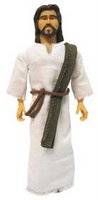
I actually think the Marine Reserves made the right call here and I can't understand why the doll's maker would be surprised by their decision. The manufacturer's director of business development says the dolls were intended as "three-dimensional teaching tools for kids." I suppose that's one way of describing them but in this case they were clearly intended as evangelistic tools in which case it would be inappropriate for a branch of the U.S. military to distribute them.

After you've read the story, check out Steve McCoy's reaction to the doll (about which you can find out more by clicking the picture).

From beliefnet:

Associated Press


LOS ANGELES, Nov 14 - A talking Jesus doll has been turned down by the Marine Reserves' Toys for Tots program.

A Los Angeles company offered to donate 4,000 of the 1 foot-(30 centimeter)-tall dolls, which quote Bible verses, for distribution to needy children this holiday season. The battery-powered Jesus is one of several dolls manufactured by one2believe, a division of the Valencia-based Beverly Hills Teddy Bear Co., based on Biblical figures.

But the charity balked because of the dolls' religious nature.

Toys are donated to kids based on financial need and "we don't know anything about their background, their religious affiliations," said Bill Grein, vice president of Marine Toys for Tots Foundation, in Quantico, Va.

As a government entity, Marines "don't profess one religion over another," Grein said Tuesday. "We can't take a chance on sending a talking Jesus doll to a Jewish family or a Muslim family."

Michael La Roe, director of business development for both companies, said the charity's decision left him "surprised and disappointed."

"The idea was for them to be three-dimensional teaching tools for kids," La Roe said. "I believe as a churchgoing person, anyone can benefit from hearing the words of the Bible."

According to the company's Web site, the button-activated, bearded Jesus, dressed in hand-sewn cloth outfits and sandals, recites Scripture such as "I tell you the truth, no one can see the kingdom of God unless he is born again" and "Love your neighbor as yourself." It has a $20 (euro15.60) retail value.

Grein questioned whether children would welcome a gift designed for religious instruction. "Kids want a gift for the holiday season that is fun," he said.

The program distributed 18 million stuffed animals, games, toy trucks and other gifts to children in 2005.

UPDATE - 11/16/07: Toys for Tots announces: "The Talking Jesus doll issue has been resolved. Toys for Tots has found appropriate places for these items. We have notified the donor of our willingness to handle this transaction."

Related Tags: , , , ,

Academic Theology as a Servant to the Church

On the heels of participating in a forum on the emerging church at Westminster Seminary (the audios of which are available from Westminster Bookstore), Scot McKnight recently gave a much-needed reminder about the need for academic theologians to learn how to speak to and write for lay people. Here's an excerpt:
The simple facts are these: lay folks aren’t learning what seminary professors are teaching their students-who-have-become-our-pastors, at least not as effectively as seminary professors sometimes think. I’ve said this before, and I’ll say it again — hoping I’ve got some new readers or some who skipped previous posts: there was a day when seminary professors and Christian college professors wrote books for layfolks, and layfolks read seminary and college professors. At that time, very few pastors wrote books — they preached and pastored.
Times have changed. Seminary and college professors are intoxicated with their rhetorics and they have learned the game, the fun game, of writing for their peers. So, they now write learned monographs — and I’ve got a little satchel of such books myself. A Light among the Gentiles and Jesus and His Death. All of this proves that we — evangelicals — have fulfilled Carl Henry’s dream or Mark Noll’s warning — that we make a contribution to culture, to theory, to education, and to intellectual history. I believe in such work.
But, not at the expense of the church. And that’s exactly what has happened. (I happened to write the other day to a seminary president about this, a person I’ve never met but whom I’ve read, and he said, “Let’s talk.”)  Here’s the truth: people have asked me if I’ll lose my reputation as an academic if I write for lay people; and I’ve been told not to write on a blog (because that is non-academic). My response has been the same: what I do, I hope, is for the glory of God and for God’s people. I love academic theology, but the academic theology that is truly designed to do what it can do better end up in the Church. Back to the observation: theological rhetoric is intoxicating, but our task is to communicate the gospel to our world in such a way that it “sings and stings.” And the time is now for seminary professors and college professors to re-learn what our task is all about. We might teach seminarians and students at advanced levels, but the fundamental goal of all Bible knowledge is to communicate that truth to ourselves and to others so that we can live it out. Not just so that we can communicate within the guild and to fellow pastors, but so we can talk to Emily Johnson and Fyodor Czechin about their issues so they can learn to live as Christians today.
Scot goes on to give some pointers, drawn from his own experience, on how we can learn to do that.

Scot's exhortation reminded me of that from another of my former professors whose wedding of theological scholarship and love for God's flock has been very influential in shaping my own aspiration to be a bridge between theological academia and the local church - Wayne Grudem.


In his 2000 Presidential Address to the members of the Evangelical Theological Society titled "Do We Act as if We Really Believe that 'The Bible Alone, and the Bible in its Entirety, is the Word of God Written'?", Grudem asked his fellow theological scholars to consider the following suggestions:
  1. Consider the possibility that God may want evangelical scholars to write more books and articles that tell the Church what the whole Bible teaches us about some current problem.
  2. Consider the possibility that God wants the Church to discover more answers and reach consensus on more problems, and wants us to play a significant role in that process.
  3. Consider the possibility that God wants evangelical scholars to speak with a unified voice on certain issues before the whole Church and the whole world.
  4. Consider the possibility that God may want many of us to pay less attention to the writings of non-evangelical scholars.
  5. Consider the possibility that God may want us to quote His word explicitly in private discussions and public debates with non-Christians.
  6. Consider the possibility that the world as we know it may change very quickly.
Thank God for those who contend against the tendency to sever doctrine from life and study from piety.

"Doctrine is not an affair of the tongue, but of the life; is not apprehended by the intellect and memory merely, like other branches of learning; but is received only when it possesses the whole soul, and finds its seat and habitation in the inmost recesses of the heart...To doctrine in which our religion is contained we have given the first place, since by it our salvation commences; but it must be transfused into the breast, and pass into the conduct, and so transform us into itself, as not to prove unfruitful." -
John Calvin, Institutes of the Christian Religion, III. VI. 4.

Thursday, November 09, 2006

Depression - It's Not Just for Grown-Ups Anymore

Mollie Murphy, a four-year-old girl in England, sad because she wasn't admitted to the same primary school as her friends from nursery, has been diagnosed by her family doctor as suffering from stress and depression and according to this Daily Mail opinion piece (HT: Psych Watch), her mother has been advised to put her on an antidepressant.

Jill Parkin, author of the Daily Mail article, expresses what I think is appropriate dismay over what little Mollie and children like her are learning and what it says about our culture:
...she's in danger of being taught a very dangerous lesson, before she can even read or write. It's a lesson that goes like this: Got a problem? Pop a pill. Finding life hard? Blame someone else.
Treating a little child with anti-depressants because she didn't get into the school she and her parents wanted is not just ridiculous and unnecessary, it is the most shocking example yet of a culture of dependency in which life's setbacks are not simply challenges to be confronted and overcome, but are medical conditions to be diagnosed and treated by 'professionals'.
I may not be a doctor, but this I can be sure of: little Mollie will get over her temporary sadness far faster without medical intervention. She needs a dose of good parenting and common sense, not Valium.
Mollie was alluded to this morning in a news segment Good Morning America ran on depression in infants (estimated as occurring in one in forty). ABC is also asking readers to vote on whether they would allow their baby to take antidepressants if doctors determined that he or she was depressed. After I voted a few minutes ago, 1,631 people had responded "Absolutely not. It's not safe," 315 replied "No. Babies can't be depressed," and 93 said "Yes. If the doctors thought it was safe then I'd be okay with it."

Two weeks ago I asked with tongue slightly in cheek, "
Can fruit-flavored, infant-formula antidepressants be too far off?" In light of the above, I'd like to ask a different question. How long will it take?

Wednesday, November 08, 2006

John Stott Praying for Apologists

Jeff Clinton's posting the following quote from John Stott's Your Mind Matters prompted me to take the thin volume from my shelf and thumb through it once more. As Jeff points out, though over 30 years old, Stott's petition is as timely today as when originally penned. I wonder, then, why we don't hear it uttered more frequently in our churches. The kind of laborers Stott prays for are not the kind that usually come to mind when we ask the Lord to send workers into his harvest :
I pray earnestly that God will raise up today a new generation of Christian apologists or Christian communicators, who will combine an absolute loyalty to the biblical gospel and an unwavering confidence in the power of the Spirit with a deep and sensitive understanding of the contemporary alternatives to the gospel; who will relate the one to the other with freshness, pungency, authority and relevance; and who will use their minds to reach other minds for Christ (52).
I was surprised to see that my copy of the book is clean, free from any underlining or marginal scribbles. That probably means that I first read it prior to getting into the habit of marking books up as I read them or I just thought it was all so good that I would have marked everything! Here's another of Stott's many noteworthy thoughts concerning why the fact that human reasoning is fallen is no excuse for failing to engage people intellectually in our evangelism:
It is quite true that man's mind has shared in the devastating results of the Fall. The "total depravity" of man means that every constituent part of his humanness has been to some degree corrupted, including his mind, which Scripture describes as "darkened." Indeed, the more men suppress the truth of God which they know, the more "futile," even "senseless," they become in their thinking. They may claim to be wise, but they are fools. Their mind is "the mind of the flesh," the mentality of a fallen creature, and it is basically hostile to God and his law.

All this is true. But the fact that man's mind is fallen is no excuse for a retreat from thought into emotion, for the emotional side of man's nature is equally fallen. Indeed, sin has more dangerous effects on our faculty of feeling than on our faculty of thinking, because our opinions are more easily checked and regulated by revealed truth than our experiences (16).

Friday, November 03, 2006

Ed Welch on Biblical Counseling

Listen to Mark Dever talk with Ed Welch of the Christian Counseling & Educational Foundation about his testimony and a variety of topics including recovery groups, codependency, medicating depression, "integrationism" and "nouthetic" counseling, and the role of counseling in the local church. (HT: Greg Linscott)

Wednesday, November 01, 2006

Helm's Deep

That's the name of philosopher and theologian Paul Helm's new blog where he will occasionally post papers that have been accepted for publication but have not yet been published.