Showing posts with label mental health. Show all posts

Monday, February 19, 2007

A President's Depression

Over at MercatorNet, psychiatrist Theron Bowers compares two different looks at Abraham Lincoln's depression. The first is from CBS Television which is running 30-second public service announcements this month featuring Lincoln and other historic sufferers of depression. The segments, part of a campaign called CBS Cares, are intended to destigmatize mental illness. Bowers explains the rationale for such campaigns and why he thinks they're of minimal help:
Current dogma assumes that depression is under-treated because people are too embarrassed to ask for help. Therefore, pinning mental illness on the coattails of giants should remove the shame attached to a condition and draw sufferers into treatment....

No helpful information is contained in the CBS commercials. Tagging room-temperature heroic figures with various human ailments yields zero insight into that person or the “illness”. Would Prozac have made Poe less creepy? Would a happier Sherman have not burned down Atlanta? You won’t find the answer at CBS Cares. Our passion for diagnosing the dead is another skin-deep facet of the diversity movement.
Bowers points to what he believes is a far more informative glimpse into Lincoln's depression and how he lived with it:
Fortunately, we can have a deeper understanding of this brilliant man and his “illness”. In 2005 Joshua Wolf Shenk provided an analysis of Lincoln and depression in his book, Lincoln’s Melancholy. Shenk goes beyond the usual agenda of the troubled genius exposĂ©. The book doesn’t settle for simply emboldening sufferers. Shenk moves the questions about Lincoln’s mood disorder from the realm of pop history and posters for Mental Health Awareness Month to the level of serious scholarship. He proclaims his ambitious goal in the subtitle of the book: How Depression Challenged a President and Fueled his Greatness
In the course of his review (which is worth reading in its entirety and caused me to add the volume to my wish list), Bowers rightly criticizes the biological reductionism that so pervades popular assumptions about the nature of depression:
Shenk elevates Lincoln from modern poster child for mental health to iconoclast against the modern biological conception of depression. Psychiatry built the medical tower of mental disorders by equating emotional suffering with disease. The American Psychiatric Association’s Diagnostic and Statistical Manual (DSM) identifies distress as a hallmark of mental disorder. The focus on distress is so entrenched that many perversions such as bestiality, sado-masochism and transvestitism are no longer classified as mental disorders unless the practitioner is “distressed” over the behavior.
Emotional suffering is only evidence of a mental disorder in the way that physical pain is evidence of disease. All aspects of depression -- brief versus chronic, mild versus severe -- have labels attached in the DSM. Sadness has no more meaning than a rash. Certain cognitive habits associated with depression are also deemed unhealthy. Hopelessness and low self esteem have acquired mythological powers for explaining our social problems.

Shenk’s Lincoln restores sanity and hope to our present notions about depression. The story of Lincoln and his troubled mind doesn’t follow any script, treatment algorithm or predictable outcomes. Lincoln’s Melancholy provides both surprising answers and true inspiration.
Related: Covenant Seminary's Zack Eswine, who describes himself as one who "wrestle[s] with a melancholy temperament and bear[s] the scars of tragic circumstances," reflects on how Lincoln and C. H. Spurgeon persevered "while suffering varying degrees of gloom." (HT: Justin Taylor)

Tuesday, February 06, 2007

A Voice Crying Out in the Therapeutic Wilderness

Amidst the biological or sociological reductionism and denial of human depravity that characterize so much of the thinking coming from mental health professions, this essay by Dr. Richard Friedman in today's New York Times is a refreshing oddity. Swimming against the tide of searching for mental illness behind every conceivable instance of bad behavior, Dr. Friedman suggests that in many (if not most) cases, the cause is something that psychiatry can neither diagnose nor cure - meanness.
When have you ever heard of a therapist telling a patient that he is mean or bad? Probably never. It’s not fashionable in our therapy-friendly nation, where people who behave obnoxiously are assumed to have a treatable psychiatric problem until proven otherwise. Nothing in the human experience is beyond the power of psychiatry to diagnose or fix, it seems. But even for me, an optimist and a proponent of therapy, things have gotten a little out of hand.
Dr. Friedman later asks whether we must "turn everything we don’t like about our fellow humans into a form of psychopathology?" That's a very important question but I don't think the tendency to boil everything down to psychopathology is primarily motivated to explain away the misbehavior of our neighbor so much as it is to excuse and justify ourselves. Psychiatric and psychological theories easily become sophisticated tools which we employ to aid us in our suppression of the truth.

Tuesday, January 23, 2007

Materialism, Materialism

When people use the word "materialism" they usually have one of two definitions in mind. Philosophically speaking, materialism is the belief that everything that exists is either composed of matter or dependent upon it for its existence. "Naturalism" is an equivalent term. Atheist and evolutionary biologist Richard Dawkins notes in his book The God Delusion that philosophers use "naturalist" as the opposite of "supernaturalist" and approvingly cites the following description of naturalistic philosophy offered by Julian Baggini in Atheism: A Very Short Introduction:
What most atheists do believe is that although there is only one kind of stuff in the universe and it is physical, out of this stuff comes minds, beauty, emotions, moral values - in short the full gamut of phenomena that gives richness to human life (13,14).
Dawkins goes on to elaborate on the implications of this philosophy for our attempt to make sense of human cognition and affect:
Human thoughts and emotions emerge from exceedingly complex interconnections of physical entities within the brain. An atheist in this sense of philosophical naturalist is nothing beyond the natural, physical world, no supernatural creative intelligence lurking behind the observable universe, no soul that outlasts the body and no miracles - except in the sense of natural phenomena that we don't yet understand it and embrace it within the natural (14).
According to this perspective human beings are essentially physiological machines whose thoughts and behaviors are reducible to biochemical and electrical impulses. We are identical with our bodies. Consequently, if anything is wrong with us it must be biological for that is all we are. Imago Dei is a useless concept for making sense of ourselves. The images critical for interpreting our condition and what ails us are MRI's and PET scans.


"Materialism" is also used to refer to an approach to life that places premium value on the acquisition of material goods for the purpose of enhancing comfort, status, and/or pleasure. Gary DeLashmutt and Dennis McCallum define materialism as "...a subtle and sophisticated worldview that defines identity, fulfillment, significance, and security in terms of economics" (129). Obviously, one who is materialistic in this sense of the word may or may not be a materialist in the previously described sense. Both kinds of materialism are dehumanizing and destructive.

Because of my interest in counseling issues, I frequently consider how they converge in the pharmaceutical industry especially in that subset that manufactures psychoactive drugs. A naturalistic worldview prevails in contemporary approaches to enhancing mental health. It is a foregone conclusion that problems such as depression and social anxiety are the results of imbalanced brain chemicals despite the fact that there is a marked disparity between the evidence and claims made by the makers of the antidepressants marketed as treatments. This is where the second sense of materialism comes in. The drug companies have a vested interest in promoting and protecting a materialistic (the first sense) view of human nature to successfully market their products. Unfortunately, ample evidence exists to demonstrate that financial gain is often a greater priority for pharmaceutical companies than public health (see, for example, the following articles chronicling Eli Lilly's attempt to suppress links between its top-selling drug, Zyprexa, and diabetes: Eli Lilly Said to Play Down Risk of Top Pill, Playing Down the Risks of a Drug, Lilly Settles With 18,000 Over Zyprexa).


Despite the advances made in Christian worldview studies, it's frustrating that more is not being done in the area of mental health. I was heartened, therefore, when in a recent FRC briefing, Discovery Institute senior fellow Dr. John West made the connection between the materialist mindset and the treatment of children diagnosed with ADHD. While affirming that drugs might be a necessary part of treatment in some cases, he noted that the rush to administer them is an outworking of materialistic assumptions that may prove detrimental and unnecessary.

As we contend against the dehumanizing and culturally destructive consequences of naturalism with respect to such things as ethics, are we turning a blind eye to how we may have imbibed the very same philosophy in the garb of medical science?

Monday, November 27, 2006

What's Wrong with a Child? The Tragic Consequences of Biopsychiatry's Naturalistic Worldview

The second in a series of articles the NY Times is doing about the increasing number of American children whose difficulties are diagnosed as serious mental disorders is entitled "What's Wrong with a Child? Psychiatrists Often Disagree." The piece could have been more accurately called "What's Wrong with Psychiatry?" for it dramatically illustrates the highly subjective nature of psychiatric diagnoses.


The article opens with an introduction to Paul Williams, a 13-year-old who "has had almost as many psychiatric diagnoses as birthdays."
The first psychiatrist he saw, at age 7, decided after a 20-minute visit that the boy was suffering from depression.
A grave looking child, quiet and instinctively suspicious of others, he looked depressed, said his mother, Kasan Williams. Yet it soon became clear that the boy was too restless, too explosive, to be suffering from chronic depression.
Paul was a gifted reader, curious, independent. But in fourth grade, after a screaming match with a school counselor, he walked out of the building and disappeared, riding the F train for most of the night through Brooklyn, alone, while his family searched frantically.
It was the second time in two years that he had disappeared for the night, and his mother was determined to find some answers, some guidance. What followed was a string of office visits with psychologists, social workers and psychiatrists. Each had an idea about what was wrong, and a specific diagnosis: “Compulsive tendencies,” one said. “Oppositional defiant disorder,” another concluded. Others said “pervasive developmental disorder,” or some combination. Each diagnosis was accompanied by a different regimen of drug treatments. By the time the boy turned 11, Ms. Williams said, the medical record had taken still another turn — to bipolar disorder — and with it a whole new set of drug prescriptions.
“Basically, they keep throwing things at us,” she said, “and nothing is really sticking.”
A caption beneath a photograph of Williams reads "In his short life, Paul has taken antidepressants, antipsychotic drugs, sleeping pills and so-called mood stabilizers." One can only wonder what such a combination of drugs is doing to this young man's developing central nervous system, not to mention other organs. Consider the fact that despite use of terms like "disorder," "diagnosis," and "illness" there are no medical tests for any of the conditions listed in the American Psychiatric Association's Diagnostic and Statistical Manual for Mental Disorders and there is even further cause to question the wisdom of administering mind-altering drugs to children or, for that matter, adults to whom psychiatric diagnoses have been given.

According to Duke University professor of psychiatry and behavioral science, Dr. E. Jane Costello, psychiatry's system of diagnosis is "
still 200 to 300 years behind other branches of medicine." This assumes, of course, that psychiatry is a legitimate medical practice, lagging behind its elder siblings. But other than the fact that its practitioners are licensed physicians with the authority to prescribe medication, what is it that biological psychiatry has in common with other fields of medicine which do not rely solely on emotional and behavioral symptoms to determine the existence of disease? To what extent is biological psychiatry a medical science? These are questions that even those within the profession have asked. In his letter of resignation from the American Psychiatric Association, the late Dr. Loren Mosher wrote:
"Biologically based brain diseases" are certainly convenient for families and practitioners alike. It is no-fault insurance against personal responsibility. We are all just helplessly caught up in a swirl of brain pathology for which no one, except DNA, is responsible. Now, to begin with, anything that has an anatomically defined specific brain pathology becomes the province of neurology (syphilis is an excellent example). So, to be consistent with this "brain disease" view, all the major psychiatric disorders would become the territory of our neurologic colleagues. Without having surveyed them I believe they would eschew responsibility for these problematic individuals. However, consistency would demand our giving over "biologic brain diseases" to them. The fact that there is no evidence confirming the brain disease attribution is, at this point, irrelevant. What we are dealing with here is fashion, politics and money. This level of intellectual /scientific dishonesty is just too egregious for me to continue to support by my membership (emphasis in the original).
I realize that to many, the idea of questioning the validity of biopsychiatry is tantamount to rejecting heliocentricity but that is just a testimony to how successfully pharmaceutical companies have indoctrinated the public (and in many cases, general practitioners) with their reductionistic philosophy of human nature. In his book Let Them Eat Prozac: The Unhealthy Relationship Between the Pharmaceutical Industry and Depression (chapters from which can be read here), Dr. David Healy, notes that the class of antidepressants known as SSRI's (selective serotonin reuptake inhibitors) has "given rise to a new language in which we understand ourselves - a biobabble to replace the psychobabble of Freudian terms that so coloured our identities during the 20th century."

To borrow terminology from the sociology of knowledge, the drug companies, in concert with the psychiatric community, have been highly effective shapers of America's plausibility structure. Leslie Newbigin, in The Gospel in a Pluralist Society defines and describes plausibility structures as:

...patterns of belief and practice accepted within a given society, which determine which beliefs are plausible to its members and which are not. These plausibility structures are of course different at different times and places. Thus when, in any society, a belief is held to be "reasonable," this is a judgment made on the basis of the reigning plausibility structure.
Biological psychiatry, like counseling, is an inescapably hermeneutic exercise. The individual seeking to assist another in resolving intra-and/or interpersonal problems inevitably makes assessments and judgments about what is going on in the individual's life. These judgments assume a system of values and beliefs about human nature, motivation, and behavior.

Multiple interpretations can be offered to account for whatever emotional and behavioral symptoms an individual reports. Likewise, multiple conceptions of what is in need of being changed and how that is to be accomplished exist. Counseling and biopsychiatry, therefore, involve placing the counselee or patient in some larger contextual framework of meaning. In other words, all approaches to counseling and/or psychiatry seek to make sense of a person and his or her situations in terms of a broad interpretive framework or worldview. Given this fact, as well as the serious health risks associated with psychiatric medications, I'm dismayed by the relative absence of Christian leaders sounding cautions against psychiatric labeling and medicating.

Thursday, November 09, 2006

Depression - It's Not Just for Grown-Ups Anymore

Mollie Murphy, a four-year-old girl in England, sad because she wasn't admitted to the same primary school as her friends from nursery, has been diagnosed by her family doctor as suffering from stress and depression and according to this Daily Mail opinion piece (HT: Psych Watch), her mother has been advised to put her on an antidepressant.

Jill Parkin, author of the Daily Mail article, expresses what I think is appropriate dismay over what little Mollie and children like her are learning and what it says about our culture:
...she's in danger of being taught a very dangerous lesson, before she can even read or write. It's a lesson that goes like this: Got a problem? Pop a pill. Finding life hard? Blame someone else.
Treating a little child with anti-depressants because she didn't get into the school she and her parents wanted is not just ridiculous and unnecessary, it is the most shocking example yet of a culture of dependency in which life's setbacks are not simply challenges to be confronted and overcome, but are medical conditions to be diagnosed and treated by 'professionals'.
I may not be a doctor, but this I can be sure of: little Mollie will get over her temporary sadness far faster without medical intervention. She needs a dose of good parenting and common sense, not Valium.
Mollie was alluded to this morning in a news segment Good Morning America ran on depression in infants (estimated as occurring in one in forty). ABC is also asking readers to vote on whether they would allow their baby to take antidepressants if doctors determined that he or she was depressed. After I voted a few minutes ago, 1,631 people had responded "Absolutely not. It's not safe," 315 replied "No. Babies can't be depressed," and 93 said "Yes. If the doctors thought it was safe then I'd be okay with it."

Two weeks ago I asked with tongue slightly in cheek, "
Can fruit-flavored, infant-formula antidepressants be too far off?" In light of the above, I'd like to ask a different question. How long will it take?

Friday, October 27, 2006

From the Couch to the Crib

Infant psychotherapy is on the rise (HT: Jeff Burton):
A widely used mental health and development diagnostic manual for infants was revised last year for the first time since 1994 to include two new subsets of depression, five new subsets of anxiety disorders (including separation anxiety and social anxiety disorders) and six new subsets of feeding behavior disorders (including sensory food aversions and infantile anorexia).
Can fruit-flavored, infant-formula antidepressants be too far off?

Tuesday, October 03, 2006

An Equal-Opportunity Disorder

The media are abuzz with the findings of a recent study indicating that men are almost as likely (5.5 percent of men) to be compulsive shoppers as women (6 percent of whom engage in the behavior).

The complete findings of the study appear in the current issue of a major national publication. No, not Cosmopolitan or GQ, as you might expect, but the American Journal of Psychiatry. If you're wondering why excessive spending is of interest to medical professionals, it's because, in yet another instance of the medicalizing of life (i.e., reducing all manner of life's problems to illness), the American Psychiatric Association claims that those who frequently experience irresistible and irrational urges to buy things suffer from a condition known as "compulsive buying (or shopping) disorder." According to one account of the study's findings, "Sufferers often rack up thousands of dollars in debt and lie to their loved ones about their purchases. The consequences can be bankruptcy, divorce, embezzlement and even suicide attempts." Researchers conclude that one in 20 adults in the U.S. "suffer" from the "condition."

What is not being as widely broadcast is the fact that this study was funded by an educational grant from Forest Pharmaceuticals Inc. (see small print at the end of the above linked article), whose speaker's bureau includes both the senior author (Lorrin Koran) and co-author (Elias Aboujaoude) of the compulsive shopping study. What makes this connection so interesting is the fact that three years ago another study, also funded by a grant from Forest Labs, reported that a commonly prescribed antidepressant called citalopram (which Forest Labs just happens to manufacture) might be useful in alleviating compulsive shopping disorder. It comes as no surprise that Lorrin Koran was this study's lead researcher as well.

Of course, the fact that those researching a drug's effectiveness are in the employ of the pharmaceutical company that manufactures it does not in itself discredit the research. However, it should at least raise suspicion about just how objective the research is. I've been doing a fair amount of reading lately about the marketing strategies of pharmaceutical companies and it's distressing, to say the least. In their book Selling Sickness: How the World's Biggest Pharmaceutical Companies are Turning Us All into Patients, Ray Moynihan and Alan Cassels write:
Psychiatry's intimate relationship with the pharmaceutical industry has become notorious. When the former New England Journal of Medicine editor Dr. Marcia Angell published her famous editorial "Is Academic Medicine for Sale?," it was this group of specialists that she chose to illustrate her point. She wrote that when journal staff were searching for an experienced and independent psychiatrist to write a review article about antidepressants, they had a great difficulty finding one, because only "very few" in the entire United States were free of financial ties to the drug makers (25-26).
Now that it has been "established" that compulsive spending is not just a women's issue, as previously thought, the market for drugs promising to treat the condition has been expanded, much to the pharmaceutical companies' glee, not to mention the relief of those now liberated from any moral evaluation of their insatiable appetites in the name of medical science.

Wednesday, September 27, 2006

Academic Doping: Success at What Cost?

Albert Mohler comments on a disturbing MSNBC report that caught my eye as well. It addresses a growing trend called "academic doping." Some parents are pressuring their teens' physicians to prescribe powerful stimulants used in the treatment of ADD/ADHD in order to enhance their academic performance - even when there's no reason to diagnose the kids with the condition.

As Dr. Mohler notes, this phenomenon involves numerous interwoven issues:

Some parents may want to blame a child's lack of academic performance on a medical condition. Others see the academic race for scholarships and college entry to be adequate reason to seek a chemical enhancement for their own kids. Parents of high achievers must wonder, "If he's doing this well without Ritalin, what could he do with it?" In any event, the promise takes the form of a pill.
We might be tempted to hastily dismiss Old Testament accounts of parents sacrificing their offspring to idols as the misguided acts of backward and primitive people. But in light of stories like this, it's apparent that we just have more sophisticated, socially acceptable, and protracted ways of killing our children to satisfy our hearts' desires (even if the object of our desire is their success).

Dr. Mohler poses the following questions to Christian parents:
How do we define success and achievement? Just what are our expectations for our kids? Are we really ready to put them on powerful stimulants, just to raise their grades and test scores? What are we teaching our kids when we do this?
These are all crucial queries but there is a more foundational issue that we should at least be willing to consider. To what degree have we thought critically about the philosophical underpinnings of biological psychiatry's claims? Ironically, while we are on one hand vehemently opposed to the dehumanizing and anti-biblical naturalism of Darwinian evolution, we seem all too ready to eat from its tree when it takes the form of materialistic psychiatry.

Increasingly, members of its own ranks are saying that the emperor has no clothes. Peter Breggin, for example, a psychiatrist who has been very critical about the over-prescribing of psychiatric medication and the pharmaceutical companies' marketing of disease in order to market their products, has called modern biological psychiatry "a materialistic religion masquerading as a science." Like the public at large, we have been well catechized (by means of pharmaceutical commercials and word of mouth) in the dogmas of "mental health." We
know for example, that depression is due to imbalanced brain chemistry despite the fact that this is a knowledge claim that even the drug companies do not make in the absence of scientific validation. We readily accept the myriad of diagnostic pronouncements based on the Diagnostic and Statistical Manual of Mental Disorders as the authoritative declarations of "science" despite the fact that no medical tests exist for any of the close to 400 labels therein described.

Just yesterday I received in the mail a book that I only recently learned of though it has been in publication since 1999 - Unholy Madness: The Church's Surrender to Psychiatry. Its author, Dr. Seth Farber, was a practicing psychotherapist for 16 years after which time he left his profession because of what he considered irresolvable conflicts between Christian theology and what he calls the religion of psychiatry. I've only been able to read the introduction and portions of the conclusion (I couldn't resist skipping ahead) and I find myself in hearty agreement with most of what I've read, especially the following excerpt from the intro (Readers familiar with Nancy Pearcey's
Total Truth and/or Francis Schaeffer's works will recognize the underlying two-tier view of truth):
The church's surrender to psychiatry has been facilitated by its tendency to subject human life to an artificial compartmentalization: private versus public, spiritual versus political, otherworldly versus worldly. For too long the church has claimed the private, the spiritual and the otherworldly as its proper domain while allowing secular authorities to dominate the public, the political and the worldly.

Since the rise of modern psychology/psychiatry there has been yet a new compartmentalization: the spiritual versus the psychological. But there are no "psychological" needs or capacities that are not spiritual. By accepting this spurious bifurcation of the spiritual into the (secular) psychological and the (nonsecular) spiritual, the church has severely compromised its authority and enabled the practitioners of the idolatrous religion of mental health to promulgate their faith system and thus to gain control over the hearts and minds (and pocketbooks) of millions of Americans. I have attempted throughout this book to demonstrate that the rationale for this usurpation of power by the mental health professions and for the abdication of responsibility by the church is specious: mental health professionals do not possess highly specialized "scientific expertise" enabling them to uniquely minister to individuals' "psychological" needs (12).
The question remains whether the constellation of symptoms called ADD/ADHD constitutes a medical disease for which any child should be given potent stimulants with potentially hazardous side effects.

Wednesday, September 13, 2006

Christians and the Psychiatric Culture


Last night I finished reading a book I mentioned here a few weeks ago, Will Medicine Stop the Pain?: Finding God’s Healing for Depression, Anxiety, and Other Troubling Emotions by Elyse Fitzpatrick and another biblical counselor, Laura Hendrickson, a physician who formerly practiced psychiatry. The book targets women since, according to the American Academy of Family Physicians, twice as many women as men will experience depression in their lifetime.Hendrickson not only prescribed antidepressants to her patients but for a period took them herself to treat diagnosed depression and bipolar disorder. She candidly relates her experiences with childhood rejection, subsequent emotional instability, and drug-induced confusion including suicidal and homicidal thoughts. Other first person accounts from Christian women who have struggled with depression appear throughout the book.

The authors explain how modern psychiatry frequently operates on the premise that human beings are reducible to our biochemical components. Intense emotional pain is therefore concluded to be the result of physical disease. They contrast this materialistic perspective with a biblical view of the person as consisting of the uniting of the outer man (the physical body including the brain) and the inner man which is referred to biblically by terms like the heart, mind, spirit, and/or soul. Fitzpatrick and Hendrickson acknowledge that the body can affect and influence the heart and vice versa. They also concede that there are real, empirically verifiable diseases of the brain (as well as brain injuries) that can have negative effects on one’s perception, cognition, and moods. However, they point out that there are no tests for so-called imbalances in brain chemistry for which antidepressants are said to be correctives. They also claim that emotional pain is intended to inform us what is going on in our hearts so that we might avail ourselves of the resources that are ours in Christ to experience heart transformation.

Fitzpatrick and Hendrickson take great pains to caution readers currently on antidepressants against deciding to go off them without medical supervision.  One of the medical professionals frequently cited is Joseph Glenmullen, a psychiatrist who teaches at Harvard Medical School and is also in private practice. I had seen him on ABC's Prime Time Live two years ago and had thought at the time of picking up one of his books but never got around to it. (Dr. Glenmullen's responses to Prime Time viewers' questions about antidepressant side effects and withdrawal are available here.) Glenmullen authored Prozac Backlash and more recently, The Antidepressant Solution which I’m in the midst of reading.
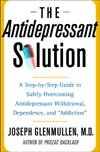
While he prescribes antidepressants on a limited basis, Glenmullen has been a very outspoken critic of the pharmaceutical companies' campaign to market them to physicians and the general public. He believes that the majority of Americans currently taking them are doing so unnecessarily. He is also very concerned that many physicians, who are often reliant upon the drug companies for their information about the drugs and their effects, are ignorant about antidepressant dependence, withdrawal, and how to safely taper patients off them. It’s frightening to learn how misleading pharmaceutical companies have been in their pushing of various medications, many times suppressing evidence of ineffectiveness and/or harmful side effects. According to Glenmullen, ample evidence exists indicating that in some people, antidepressants can create the very symptoms they were prescribed to treat. And in some cases, such a dependence is built that serious symptoms can result from forgetting to take the pills at their proper time. When this happens, patients often think that they are having a relapse when, in actuality, the drug is responsible for their problems.
I can't recommend the above books highly enough to those taking antidepressants (whether male or female) and those who care about someone who is. Readers may also be interested in acquiring a Mars Hill Audio Journal interview with David Healy, a British psychiatrist and author of The Antidpressant Era and more recently Let Them Eat Prozac: The Unhealthy Relationship Between the Pharmaceutical Industry and Depression on antidepressants and the concept of disease.

When one takes into consideration that the disorders the psychiatric community labels people with, are not scientifically validated, there is much cause for both alarm and caution. I’m especially concerned because I know numerous Christians who have bought the well-publicized line that taking antidepressants is analogous to taking insulin or other medication designed to treat biologically detectable illnesses. In a chapter on biological psychiatry in his book Seeing With New Eyes: Counseling and the Human Condition Through the Lens of Scripture, David Powlison makes what I believe is an accurate observation:
The church typically lags a bit behind the culture's way of thinking. But the ethos and practice of biopsychiatry are deeply affecting the church already. If it's broken, or even just not working optimally, it can be fixed from the outside by a drug: better living through chemistry. In your ministry and in your church you are probably already facing the ethos and the practices. Many people in both pew and pulpit are on mind-, mood-, and behavior-altering drugs. We all increasingly face the ideas and knowledge claims, too. The cover story in Time magazine informs the everyday queries and choices of Christian people. Eventually such ideas make it into the educational system as the received wisdom of the culture with which to disciple the next generation (p. 243)
The more believers uncritically accept the therapeutic ethos that so permeates our culture, the less relevant and precious the gospel will seem.

Related Tags: , , , , , , , , , , ,

Friday, May 26, 2006

Busting a Drug Myth

Theodore Dalrymple, author of Romancing Opiates, calls commonly held beliefs about opiate addiction and withdrawal poppycock:

Heroin doesn't hook people; rather, people hook heroin. It is quite untrue that withdrawal from heroin or other opiates is a serious business, so serious that it would justify or at least mitigate the commission of crimes such as mugging. Withdrawal effects from opiates are trivial, medically speaking (unlike those from alcohol, barbiturates or even, on occasion, benzodiazepines such as valium), and experiment demonstrates that they are largely, though not entirely, psychological in origin. Lurid descriptions in books and depictions in films exaggerate them Ă  la De Quincey (and also Coleridge, who was a chronic self-dramatizer).
I have witnessed thousands of addicts withdraw; and, notwithstanding the histrionic displays of suffering, provoked by the presence of someone in a position to prescribe substitute opiates, and which cease when that person is no longer present, I have never had any reason to fear for their safety from the effects of withdrawal. It is well known that addicts present themselves differently according to whether they are speaking to doctors or fellow addicts. In front of doctors, they will emphasize their suffering; but among themselves, they will talk about where to get the best and cheapest heroin.
When, unbeknown to them, I have observed addicts before they entered my office, they were cheerful; in my office, they doubled up in pain and claimed never to have experienced suffering like it, threatening suicide unless I gave them what they wanted. When refused, they often turned abusive, but a few laughed and confessed that it had been worth a try. Somehow, doctors—most of whom have had similar experiences— never draw the appropriate conclusion from all of this. Insofar as there is a causative relation between criminality and opiate addiction, it is more likely that a criminal tendency causes addiction than that addiction causes criminality.
Dalrymple offers the following explanations for the perpetuity of what has become the "orthodox view" about opiate addiction:
First, the literary tradition sustains it: Works that deal with the subject continue to disregard pharmacological reality, from De Quincey and Coleridge through Baudelaire, Aleister Crowley, Bulgakov, Cocteau, Nelson Algren, Burroughs and others. Second, addicts and therapists have a vested interest in the orthodox view. Addicts want to place the responsibility for their plight elsewhere, and the orthodox view is the very raison d'ĂȘtre of the therapists. Finally, as a society, we are always on the lookout for a category of victims upon whom to expend our virtuous, which is to say conspicuous, compassion. Contrary to the orthodoxy, drug addiction is a matter of morals, which is why threats such as Mao's, and experiences such as religious conversion, are so often effective in "curing" addicts.

Saturday, March 18, 2006

Poli Psych

Glenn (Instapundit.com) and Dr. Helen Reynolds recently talked to Dr. Nicholas Cummings about the politicization of psychology (HT: Stones Cry Out). Here's their summary:


Is psychology over-politicized? We interview Dr. Nicholas Cummings, a past President of the American Psychological Association, and coauthor of Destructive Trends in Mental Health: The Well-Intentioned Path to Harm, about the injection of politics into mental health in general, and the American Psychological Association in particular. Plus, why men are disappearing from the psychological profession.
You can listen to the podcast directly (no iPod needed!) by clicking right here, or you can get it via iTunes right here.
I blogged about the book here and here. Tom Gilson at Thinking Christian has also written about how a liberal political ideology, rather than sound research, appears to be driving the APA's stance on abortion and homosexual marriage.

Friday, February 24, 2006

The APA's Social Vision

Tom Gilson at Thinking Christian points to the American Psychological Association's apparent dismissal of a recent study indicating that abortion has adverse effects on women's mental health and asks, "...is the APA a civil rights organization? Should civil rights trump their advocacy for mental health? What's really going on here politically, anyway?" 


This isn't the first time the self-professed scientific and professional community has opted for activism over research. Nicholas Cummings, a former APA president and co-editor of the book Destructive Trends in Mental Health, claims that the Association only conducts research "when they know what the outcome is going to be...only research with predictably favorable outcomes is permissible." In this article about the APA's stance toward homosexuality, Cummings describes an exchange he had with another member at a meeting convened to discuss the future of the organization:
I was just about to agree with one of the participants, when she stopped me before I could speak: 'I don't know what you are going to say, but there is nothing you and I can agree on, because you are a straight white male and I am a lesbian.'
He continues:
Such blatant reverse discrimination was overlooked by everyone else in the room, but I was dumbfounded. This woman is prominent in APA affairs, is extensively published, and has received most of the APA's highest awards. The APA continues to laud her, even though recently she had her license suspended for an improper dual relationship with a female patient! What would be the response had it been a straight white male in an improper dual relationship with a female patient?
A message from current APA President Gerald P. Koocher states in part: "Healthy, well-adjusted people build better societies, and improving societal institutions builds better people. Psychology has much to contribute, and we must do a better job of making these potential contributions self-evident." 


This appears to be a commendable goal but there are important questions we need to ask in response to assertions like this. What criteria will we use to evaluate health and well-adjustedness? What ideals should guide our attempts to improve society? Which conception of the good life should we follow? More important, which is true?


Psychological research may prove quite helpful in giving us insight into how we think and behave but it cannot tell us how we should be thinking and behaving. Even our interpretations of what we observe are dependent upon some pre-scientific beliefs about what it means to be human, whether or not there is a teleology or purpose for our existence, and what is ultimately real. 

When we take the time to reflect on these issues, the well-worn plea for neutrality in the public square is more clearly seen for what it is - nonsense. Someone's philosophy of life will dictate public policy. This means that Christians need not be ashamed or embarrassed for thinking "Christianly" (to use a phrase coined by Harry Blamires) about psychology or any other facet of life. To conform to the myth of neutrality is, in fact, to betray the faith.

Tuesday, September 20, 2005

Destructive Trends in Mental Health

This extensive review of the new book Destructive Trends in Mental Health: The Well-Intentioned Path to Harm persuaded me to add it to my ever-growing "to read" list. The volume is edited by Rogers H. Wright and Nicolas A. Cummings who have served in leadership capacities within the American Psychological Association (APA) and who refer to themselves as "lifelong liberal activists." That self-description makes them unlikely candidates for editing this volume which sounds an alarm about how political correctness and other elements of ultra-liberal ideology exercise influence over the APA at the expense of scientific research and the welfare of patients. Here are a few interesting excerpts from the review:

The editors of this volume provide compelling arguments for many destructive trends in the mental health professions - most particularly, psychology, but also psychiatry and social work. They demonstrate from an insider's perspective how activism masquerades as science in the APA, and how "diversity" has been redefined into a kind of narrow politicism, where differing worldviews are not only summarily dismissed, but the holders of such views actually punished.
Wright says there are many treatments advocated by psychology with little or no evidence of efficacy - for example, grief and trauma counseling, treatment of repressed memories regarding sexual abuse, as well as the extensive use (or abuse) of medications for questionable diagnoses of depression and ADD/ADHD.
The authors note that there is no empirical data on political correctness because it is "politically incorrect to question political correctness" (p. 22). They post two questions regarding political correctness, and offer a number of hypotheses for potential testing. The questions are: "What psychological functions does political correctness fulfill for the individual?" and "What is the attraction of political correctness to certain personalities?" The hypotheses offered to understand these behavioral phenomena include:
  • Political Correctness Harbors Hostility
  • Political Correctness Reflects Narcissism
  • Political Correctness Masks Histrionics
  • Political Correctness Functions as Instant Morality
  • Political Correctness Wields Power
  • Political Correctness Serves as Distraction
  • Political Correctness Involves Intimidation
  • Political Correctness Lacks Alternatives
A chapter devoted to children called "The Diseasing of America's Children" addresses the myth that childhood behavior disorders are caused by genes, noting that there is no good scientific evidence. Rosemond concludes, "The perpetrators of the disease model of behavior disorders engage in disingenuous misleading arguments" (p.223). He notes that psychologists have confused biological conditions with developmental ones, citing the DSM [Diagnostic & Statistical Manual] criteria for a pathological antisocial condition which he says "perfectly describes the terrible twos!" (p. 226).
This new book provides a window into the American Psychological Association and into psychology in [a] way hithertofore only suspected. The courage demonstrated by Wright and Cummings is unparalleled. Their professional and scientific accomplishments and their positions of prominence in the American Psychological Association, along with their reasoned, evidence-based arguments, make their work essentially unassailable. Though the authors of the various chapters are critical in their judgments, their judgments are supported by evidence and their informed opinions.