Showing posts with label Christian marketing. Show all posts

Wednesday, December 06, 2006

Marketing the Good Book

Joanne Kaufman of the Wall Street Journal writes about the measures to which Bible publishers go to connect with consumers. Fortunately, not all proposed versions, like the "alarmist Bible" pitched to Thomas Nelson, are approved:
The offering featured headlines that had been snipped from the front pages of USA Today, then pasted below select New Testament verses. Also included was some newspaper boldface about the collapse of the Jessica Simpson-Nick Lachey marriage accompanied by relevant text from Scripture, presumably not Genesis' 2:24 dictum: "a man shall leave his father and his mother and shall cleave unto his wife."
Some interesting excerpts:

Thomas Nelson produces 150 different editions of the Bible each year.

Christian bookstores had a 25% increase in sales of Scriptures from 2003 to 2005
...Bibles are becoming as much personal statements as fashion statements. "What people are saying is 'I want to find a Bible that is really me,'" noted Rodney Hatfield, a vice president of marketing at Thomas Nelson. "It's no different than with anything else in our culture."
Fortunately for Bible publishers, consumers seem to think that if one copy of the Good Book is good, two or more are even better. "Forty percent of my customers own three to 10 Bibles," said Mr. Hastings. "It's sort of like me and golf. I have Tiger Woods's book and Ernie Els's book. I want all those different approaches to how to play golf. It's the same with Bibles."

Tuesday, November 14, 2006

Toys for Tots Says No Jesus Dolls Under the Tree This Year

I actually think the Marine Reserves made the right call here and I can't understand why the doll's maker would be surprised by their decision. The manufacturer's director of business development says the dolls were intended as "three-dimensional teaching tools for kids." I suppose that's one way of describing them but in this case they were clearly intended as evangelistic tools in which case it would be inappropriate for a branch of the U.S. military to distribute them.

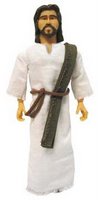
After you've read the story, check out Steve McCoy's reaction to the doll (about which you can find out more by clicking the picture).

From beliefnet:

Associated Press


LOS ANGELES, Nov 14 - A talking Jesus doll has been turned down by the Marine Reserves' Toys for Tots program.

A Los Angeles company offered to donate 4,000 of the 1 foot-(30 centimeter)-tall dolls, which quote Bible verses, for distribution to needy children this holiday season. The battery-powered Jesus is one of several dolls manufactured by one2believe, a division of the Valencia-based Beverly Hills Teddy Bear Co., based on Biblical figures.

But the charity balked because of the dolls' religious nature.

Toys are donated to kids based on financial need and "we don't know anything about their background, their religious affiliations," said Bill Grein, vice president of Marine Toys for Tots Foundation, in Quantico, Va.

As a government entity, Marines "don't profess one religion over another," Grein said Tuesday. "We can't take a chance on sending a talking Jesus doll to a Jewish family or a Muslim family."

Michael La Roe, director of business development for both companies, said the charity's decision left him "surprised and disappointed."

"The idea was for them to be three-dimensional teaching tools for kids," La Roe said. "I believe as a churchgoing person, anyone can benefit from hearing the words of the Bible."

According to the company's Web site, the button-activated, bearded Jesus, dressed in hand-sewn cloth outfits and sandals, recites Scripture such as "I tell you the truth, no one can see the kingdom of God unless he is born again" and "Love your neighbor as yourself." It has a $20 (euro15.60) retail value.

Grein questioned whether children would welcome a gift designed for religious instruction. "Kids want a gift for the holiday season that is fun," he said.

The program distributed 18 million stuffed animals, games, toy trucks and other gifts to children in 2005.

UPDATE - 11/16/07: Toys for Tots announces: "The Talking Jesus doll issue has been resolved. Toys for Tots has found appropriate places for these items. We have notified the donor of our willingness to handle this transaction."

Related Tags: , , , ,

Thursday, October 12, 2006

Kitschy, Kitschy, Coo


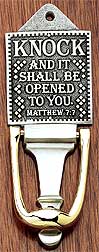
For a satirical look at items like this divine door knocker (I wonder, can I get that in a Revelation 3:20, instead?), check out kinda kitschy, a blog whose tagline reads: "The world is laughing at us. So am I."


Speaking of kitsch, Quentin Schultze made the following observation about its use in worship in By Faith magazine (HT: Phil Ryken):

Young people witness some of the cheesy video and computer 'art' in worship and see it for what it is: kitsch. Stock clip art. Old-fashioned, 19th-century background images under song text: the sun shining on the cross, running streams, baby faces--all of the stereotypical images that say, 'Christians are crummy artists and naive sentimentalists.' To them, such kitsch is like handing out illustrated kids' Bibles to high school students and telling them that these images represent the depth of insight and excellence of the Christian faith.

Thursday, August 24, 2006

Jason Janz on Jesus Junk

Jason Janz at SharperIron gives an eyewitness report (complete with photos) of his experience at the recent Christian Bookseller's Association Convention International Christian Retail Show. He asks, "Why do we as Christians, feel compelled to plaster our 'faith' over anything and everything?" (a question I took a partial stab at recently) and offers the following reasons:

  1. Many people trust that wearing Jesus Junk will result in conversions.
  2. Many Christians believe Jesus Junk promotes Christian community.
  3. Many people seem to be in the business for pure commercialism.
He concludes with five thoughtful questions believers should ask before buying more Christianized merchandise.

I don't know. Jason makes a persuasive case but I'm still tempted to get my son fitted for that neat armor of God outfit he photographed.

Wednesday, August 16, 2006

Driving the Marketplace Out of American Christianity

A handful of people were directed to a recent post on Christian retailing after doing searches for "gospel golf balls" or something similar. The LA Times article linked to in that post quotes Alan Wolfe, a non-Christian sociologist who has done a lot of research about American evangelism. When asked what he thinks the proliferation of Christianized products reveals, Wolfe replied, " "It's as if they're saying the task of bringing people to Jesus is too hard, so let's retreat into a fortress."


The above searches in combination with the fact that just last week someone offered me a fish-shaped "Scripture Mint" prompted me to link to this interview of Wolfe by Russell Moore on a recent broadcast of the Albert Mohler Program (HT: Justin Taylor) in which Wolfe had more indicting commentary about Christian retailing. It's painful listening because so much of what he offers as reasons for the mass production of so-called evangelistic merchandise is true.

I think there's another reason behind the impulse to stamp a Scripture verse on every imaginable object. In large part we have an anemic doctrine of creation. Our conviction that God is the maker of heaven and earth should be evidenced in more ways than ongoing debates with evolutionists. Certainly, there's a need for such apologetic activity but the doctrine of creation, like all biblical doctrines, is not given primarily for the purpose of our defending it but for our living it.

How do we live the doctrine of creation? By affirming along with God that his creation, though cursed on account of humanity's rebellion, is still good and is given to us to richly enjoy with thanksgiving (1 Timothy 4:4; 6:17). As Michael Wittmer says in his book, Heaven is a Place on Earth:


Because we know that this creation is the good gift of God, we are not only permitted but encouraged to enjoy it as is. Unlike those who think that worldly objects are somehow enhanced by stamping Scripture verses on them, Christians who understand the goodness of this world celebrate the freedom to enjoy God's creation as is. We no longer need to sanitize secular items with our sanctified slogans to make them suitable for Christian consumption....In fact, our feeble attempts at baptizing creation tend to cheapen both it and the gospel (p. 66-67).
If believers really grasped this, many Christian businesses would go belly up and perhaps Christian "bookstores" would become bookstores again.

By the way, if you'd like a concentrated dose of the kind of creation- and gospel-trivializing merchandise Wittmer refers to, the Ship of Fools' collection of Gadgets for God is hard to beat. Among their current list of top-ten products is a lanyard and cap designed to convert your iPod Shuffle into a cross. Click the picture for their description and ordering information.

Tuesday, January 03, 2006

Christians and Kitsch

A few months ago I used the phrase "kitschianity" to describe the evangelical propensity toward creating sentimental works of poor quality (for lack of a better word) art intended to convey some aspect of the Christian message. These articles line the shelves of what used to be Christian bookstores. So, while paging through the current issue of Books & Culture this morning, I took special note of an ad for a new book from a UK-based publishing company called Piquant Editions that specializes in the relationship between Christian mission and the arts. The book is called A Profound Weakness: Christians and Kitsch by Betty Spackman. Here's Piquant's description:
In this image journal and textbook, the contemporary artist Betty Spackman takes us on a guided tour of her collection of the images and objects that represent the Christian faith in popular culture. Having set out to critique these poor relations of ecclesiastical art, she finds herself torn between being deeply moved and outraged by their sentimental appeal. Her gentle deconstructions and playful permutations elicit new life from them to illustrate her observations, and to surprise and at times unsettle the reader. A closing questionnaire prompts further reflection. This is a book that can help us greatly to make sense of the pictures that unwittingly may have shaped our faith or unfaith. It is highly recommended for artists, teachers, preachers, youth leaders, parents and spiritual counsellors.
An information page (PDF) including the table of contents and a brief author's bio is available here.

Oh, by the way, Happy New Year!

Tuesday, December 06, 2005

The Sermon, the Pitch, and the Cashbox

12/7/05 - updated with related posts below

I confess. I've been counting down the days until the release of The Lion, the Witch, and the Wardrobe. Friday evening I'll be joining a large group from my church to view the film. While at the theater I'll try to put all the marketing hype surrounding the production out of my mind so as not to ruin my enjoyment. As David Wayne notes in his musing about the promotional fervor, "Just as Aslan is on the move in Narnia, so the servants of Mammon are on the move in our world seeking to make us evangelicals their servants." Like David, I too thought back to Tim Challies' question of just how crassly the church is being used to market the new Narnia film as I've witnessed all the hype.


When I read at Reformation 21 that according to the Philadelphia Inquirer Walt Disney Pictures is sponsoring a promotional sermon contest whose winner will be given $1,000, I was shocked. I couldn't believe that Disney would go so far as to sponsor a contest designed to get pastors to give verbal trailers from the pulpit. It just didn't seem like good business sense. Such an offensive move could alienate members of the very audience Disney is banking on to make the film a success.

After a little searching I found what at first appeared to clear Disney of such crass publicity seeking. The "Narnia Sermon Sweepstakes" is sponsored by
SermonCentral.com which claims to be the world's largest sermon research site. In addition to $1,000, the grand prize winner will receive a trip for two to London and Oxford, England to walk where Lewis walked and worshiped. All a pastor has to do to enter the competition is submit a qualifying Narnia-related sermon transcript or outline. Apparently it's not necessary that the sermon actually have been preached but the odds are good that if a pastor has expended the time and effort to compose such a message, it will get preached. And those entries that are eventually posted on SermonCentral's site will probably be preached in some form or another from numerous pulpits. The Inquirer claims that Disney is using hired agencies to promote The Lion, the Witch, and the Wardrobe in churches. Among them is Outreach Media Inc. which, according to the article, hosts the sermon contest. At first, I thought this was an error having read at SermonCentral.com that it was sponsoring the contest. However, when I visited SermonCentral's page for potential advertisers, I learned that it is an arm of Outreach Media and thus it appears that the sermon contest is indeed another Disney marketing strategy.


Outreach Media Inc. affirms Christian orthodoxy and states its vision as follows: "To create a network of churches and ministries working together to love and serve people with the goal of inviting every person in America to a local Bible believing church and, ultimately, into a personal relationship with Jesus Christ." I'm sure there are sincere believers at Outreach who are eager to promote the Narnia film because they are persuaded that it has the potential to turn minds toward contemplation of the gospel. However, given their being in Disney's employ, the decision to run a sermon sweepstakes is a matter of very poor judgment. It may lead some to conclude that the folks at Outreach have succumbed to the craving for Turkish Delight.


RELATED:

Christianity Today asks, "Did Disney Pay for Your Sermon?" and likewise questions "the propriety of offering financial incentives for pastors to preach on a commercial product, even if it is Narnia."

Paul C. at Theospeak.net has a few questions of his own: "What's next, pastors wearing suits emblazoned with sponsor's logos like a NASCAR driver? Maybe cash strapped churches could sell commercial breaks during services to help raise funds?"

Friday, November 04, 2005

Girlcotting Abercrombie & Fitch

Abercrombie & Fitch once again reveals its penchant for raunchiness, this time by selling t-shirts for young women with "Who needs brains when you have these?" strategically printed on the chest. In response, a group of high school girls in Allegheny County, PA are "girlcotting" (as opposed to boycotting) the retailer. Emma Blackman-Mathis, one of the leaders of the group, told Newsday, "We're telling [girls] to think about the fact that they're being degraded. We're all going to come together in this one effort to fight this message that we're getting from pop culture."

Unfortunately, those messages are sent to girls long before they reach high school. This summer as my wife and I searched for back to school clothing for our daughter, we were frustrated by how difficult it was to find t-shirts that didn't have some objectionable wording on them. If they weren't inappropriately suggestive, many communicated self-centered, anti-authority attitudes that we don't want our young lady identifying with.


That reminds me. One of the ways Christian retailers have tried to encourage young girls and teens to dress modestly is by producing t-shirts with their own message emblazoned on the front: "Modest is Hottest!" While I appreciate the motive (assuming that more than commercialism is at work), I think the method is worth questioning. It seems to me that there's something wrong with trying to persuade Christian young people to adopt modesty on the grounds that it is the superior path to "hotness." 

Regardless of how effective the Pennsylvania girlcott is, the young organizers are to be applauded for their willingness to swim upstream. I hope other bloggers will draw attention to what they're doing and let them know that they have our support.

Saturday, September 10, 2005

Standing on the Promises of God - Literally

A company in Ohio is marketing shoe inserts with Bible texts printed on them called "In-Souls". You can even purchase a companion journal to record your experience standing on God's word. Can a collection of the writings of John Bunion be far behind?

To get an idea about some of the folks who might have inspired the makers of this line, check out the site's ministry links. [HT: Between Two Worlds]


UPDATE: I just 'stumbled' across this article about "In-Souls" and the woman behind them. According to the article, the inserts are being sold in 25 stores nationwide including two Borders Books & Music stores and, most appropriately, Walk of Faith Christian Bookstore.

Tuesday, July 26, 2005

Worthwhile Reads About Christian Marketing and Media

Murdock at The A-Team Blog conducted an interview with Richard Abanes, author of Rick Warren and the Purpose that Drives Him. He posted Part I today. In it he asks Abanes to respond to the suspicion of some that his book is a part of the Purpose-Driven marketing strategy.
 
Speaking of Purpose-Driven marketing, Tim Challies thinks there's reason to believe that the release of a new book by the marketing genius behind The Purpose-Driven Life is being stalled due to pressure from Rick Warren.

Phil Johnson, the Pyromaniac, says that virtually all of the people on Time Magazine's list of "The 25 Most Influential Evangelicals" are "fadmakers." Phil's answer to why evangelical churches are so prone to jumping on bandwagons? "A few years ago, marketing experts learned how to tap into evangelicals' infatuation with the cheap and tawdry and turn it into cash." (Something tells me Phil could come up with some winning "Pious Products").
Of all Phil says, I found the following most disturbing though not surprising:
When it comes to books, have you noticed how few truly timeless and significant volumes are being published? That's because nowadays, decisions about what to publish are driven by marketeers who have little concern for the spiritual or editorial content of a book. I have sat in meetings with publishers while their marketing experts vetted concepts for new books. "That one's too biblical." (Those are the exact words one of these Christian kitsch-peddlers actually once said in my presence to a roomful of nodding experts from the Christian publishing industry...)
Doug Groothuis explains why he thinks television doesn't lend itself to apologetics (despite Lee Strobel's commendable efforts) and calls for "medium exegesis":

American evangelicals are populists. They have always labored to reach as many people as possible for Christ using every available means and method. This motivation is praiseworthy, but should be tempered with media exegesis. Some media are not well suited for some topics and issues. Television, as I have argued in Truth Decay, favors the image over the word; it also favors certain kinds of personality (the charismatic, simplistic, telegenic, image-oriented communicator) over character and intellectual ability. Television has little patience for carefully developed arguments or nuances.

Sunday, July 24, 2005

This Little Light of Mine

After tossing and turning due to the unbearable heat a few mornings ago, I finally went downstairs to turn on the air conditioner. Wanting to give time for the cool air to circulate upstairs I plopped down on the couch and turned on the television. Flipping through the myriad of early morning infomercials, I came upon The New Jim Bakker Show, broadcasting from the entertainment capital of the midwest, Branson, MO.
 
The scene was disturbingly familiar - Jim seated next to his new wife, looking into the camera and asking viewers to send a "donation." You know, those "suggested donations" in exchange for which the donor receives a "gift" from the ministry. The gift Jim was promoting was a battery-free flashlight that gives an hour of light after being powered by 60 seconds of cranking with a detachable crank. But this isn't just any flashlight. It's a "Revelation Generation LifeLight" with the reminder that "Jesus is the light of the world" printed in gold on its side. (It occurred to me today that this isn't really a gospel searchlight since one only receives illumination by works but that's another story.)

It wasn't long before my twisted sense of humor went to work thinking of other common objects that could be Christianized with the addition of a Bible verse. Here are two potential items:
  • Plant food with "I will restore to you the years that the locust hath eaten" printed on the package
  • Permanent markers reading "I will never leave you nor forsake you."
Feel free to leave your ideas for Pious Products in a comment.

Of course, one doesn't have to suffer from bouts of insomnia to find similar objects. Christian bookstores (do they still call them bookstores?) are filled with them. Consumerism is in large part the force behind the marketing of prooftexted merchandise but I think Mike Wittmer is right when he traces this phenomenon to a deficient doctrine of creation and its goodness. In Heaven Is a Place on Earth he writes:
....we don't need to stamp Christianity on something before we can enjoy it. In fact, our feeble attempts at baptizing creation tend to cheapen both it and the gospel. Printing "cross-training" or "cross-eyed" on a T-shirt trivializes both the cross (do we really want to compare Jesus' suffering to a type of exercise or astigmatism?) and ordinary T-shirts (which are perhaps not as good as those with religious slogans). The same holds true for spill-proof cups emblazoned with John 4:14 -- "whoever drinks the water I give him will never thirst"; key chains that parody milk advertisements with the probing question "Got Jesus?"; dinner plates that claim to be "Home Grown and Heaven Bound"; and stuffed ducks wearing rain gear on account of recurring "Showers of Blessing" (honestly, I could not make this stuff up). Rather than improve creation, such silliness only distracts from the goodness that is already there while mocking the gospel it seeks to advertise (p. 67).
Well, it's early yet and I've not fully woken up so I'm going to get some coffee. Now, where'd I put my Miracle Mug?